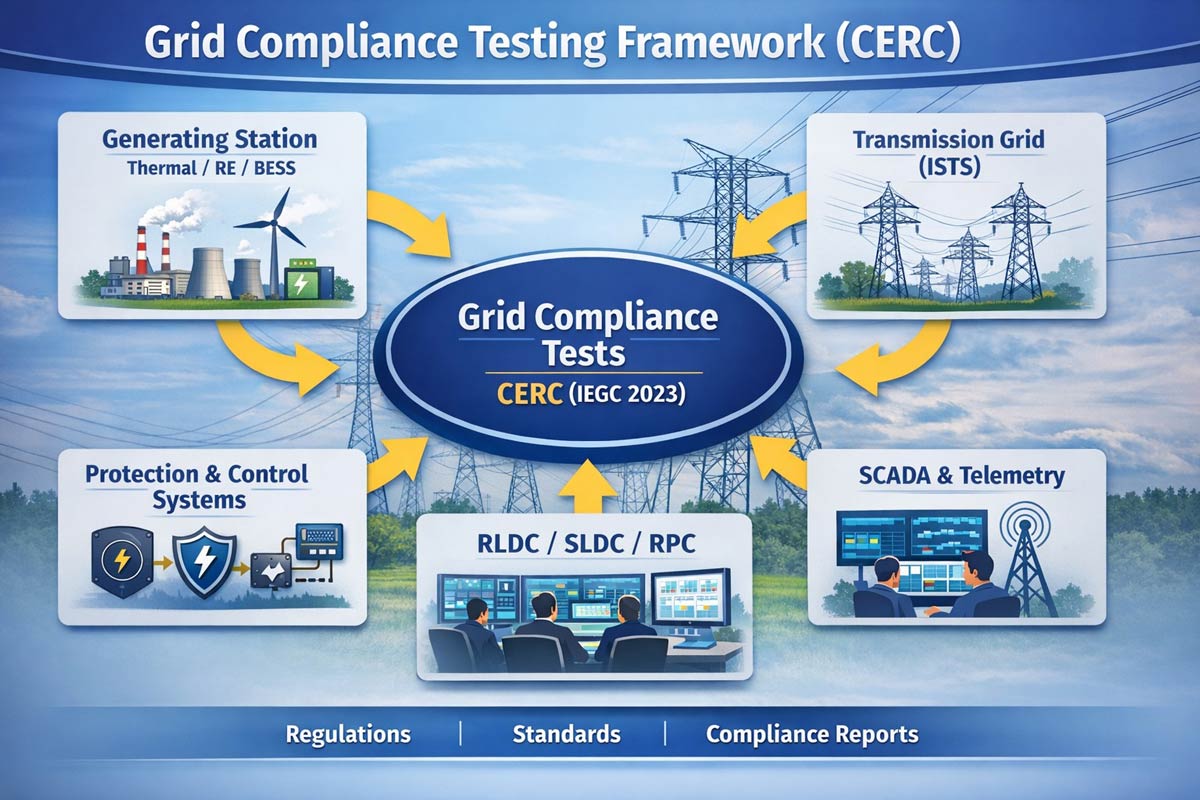
With increasing renewable penetration, complex power electronics, and inter-regional power transfers, grid security has become a critical regulatory priority in India. To ensure that generating stations, transmission systems, and grid-connected entities operate in harmony with the national power system, the Central Electricity Regulatory Commission (CERC) mandates Grid Compliance Tests under the Indian Electricity Grid Code (IEGC), 2023 and associated regulations.
Grid compliance testing serves as a formal mechanism to verify that power system elements meet prescribed technical, operational, and performance standards before and during grid connectivity. For power utilities and developers, these tests are not only a regulatory obligation but also a foundational requirement for safe and stable grid operation.
Regulatory Framework
Grid compliance testing requirements are primarily governed by:
- CERC (Indian Electricity Grid Code) Regulations, 2023
- CERC (Connectivity and General Network Access) Regulations
- CERC (Grid Standards) Regulations
- Applicable CEA Technical Standards and RPC procedures
Under these regulations, all grid-connected entities — including generating stations, transmission licensees, distribution utilities, and renewable energy plants — must demonstrate compliance with defined grid parameters at the time of commissioning and during operation.
Objectives of Grid Compliance Tests
The core objectives of grid compliance testing include:
- Ensuring safe synchronization with the grid
- Verifying frequency, voltage, and reactive power performance
- Assessing fault ride-through capability
- Confirming protection system coordination and response
- Preventing grid disturbances and cascading failures
- Ensuring compliance with Load Despatch Centre (LDC) operational requirements
Applicability of Grid Compliance Tests
Grid compliance tests are applicable to:
- New generating stations (thermal, hydro, nuclear, solar, wind, hybrid)
- Expansion units or capacity augmentation
- Transmission substations and lines at 220 kV and above
- Inverter-based resources connected to the ISTS
- Existing plants when directed by RPC / RLDC / CERC following grid events
Types of Grid Compliance Tests
1. Frequency Response and Governor Performance Tests
These tests validate the generating unit’s ability to respond to frequency variations in accordance with IEGC provisions.
Key Checks:
- Governor droop characteristics
- Primary frequency response
- Dead band settings
- Ramp rate compliance
2. Voltage and Reactive Power Capability Tests
These tests ensure that the generating station can operate within prescribed voltage limits and provide reactive power support.
Key Checks:
- Operation within voltage control band
- Reactive power absorption and injection
- Automatic Voltage Regulator (AVR) performance
- Power factor compliance at grid interface point
3. Fault Ride Through (FRT / LVRT / HVRT) Tests
Mandatory for renewable and inverter-based generating stations, these tests confirm the plant’s ability to remain connected during grid disturbances.
Key Checks:
- Low Voltage Ride Through (LVRT)
- High Voltage Ride Through (HVRT)
- Post-fault recovery behavior
- Protection coordination during faults
4. Protection System and Islanding Tests
These tests verify correct operation of protection schemes during abnormal grid conditions.
Key Checks:
- Anti-islanding protection
- Under/over frequency and voltage protection
- Time coordination with grid protection
- Relay settings as per approved philosophy
5. SCADA, Telemetry, and Communication Tests
Ensures real-time data availability and control from LDCs.
Key Checks:
- Real-time MW, MVAR, voltage, frequency data
- Telemetry accuracy
- Remote control and signal validation
- Event and disturbance recording
Test Procedure and Coordination
Grid compliance tests are conducted in coordination with:
- Regional Load Despatch Centre (RLDC)
- State Load Despatch Centre (SLDC)
- Regional Power Committee (RPC)
- Transmission licensee
The typical process includes:
- Submission of test procedure and schedule
- Approval by concerned LDC
- Test execution under real-time supervision
- Data recording and analysis
- Submission of compliance report
Reporting and Certification
Post-test, a Grid Compliance Test Report is prepared, containing:
- Test methodology
- Recorded data and plots
- Observations and deviations
- Compliance statement
- Recommendations, if any
The report is submitted to the concerned LDC/RPC, and compliance certification is issued upon satisfactory results. Non-compliance requires corrective action and repeat testing.
Importance of Grid Compliance Tests
Grid compliance testing provides multiple operational and strategic benefits:
- Regulatory compliance with CERC mandates
- Reduced risk of grid disturbances
- Improved system reliability and resilience
- Faster approvals for commissioning and commercial operation
- Enhanced confidence of system operators
Role of Wire Consultancy
Wire Consultancy supports utilities and developers across the complete grid compliance lifecycle, including:
- Regulatory interpretation and compliance planning
- Test procedure preparation and coordination with LDCs
- On-site test supervision and data analysis
- Protection and control system validation
- Preparation and submission of compliance reports
Through technical expertise and regulatory alignment, Wire Consultancy enables clients to achieve seamless grid integration while meeting all CERC requirements.
Grid compliance tests form a cornerstone of India’s power system governance framework under CERC. As the grid evolves with higher renewable integration and dynamic operating conditions, rigorous compliance testing ensures that every connected entity contributes positively to system stability. Proactive planning, expert execution, and timely reporting — supported by experienced consultancies — are essential for achieving both compliance and operational excellence.