Board and Management Team Needs to Know
Not long ago, ESG ratings lived quietly inside the sustainability team’s inbox. Today, they show up in board meetings, customer contracts and investor calls.Customers are asking suppliers for sustainability scores before signing purchase orders. Investors are pricing ESG risk into valuations. Banks are factoring sustainability performance into lending decisions. Global procurement teams now screen vendors on environmental, social and governance criteria as routinely as they check for quality certifications.
The result: a company’s ESG rating can now quietly influence customer retention, new business wins, supplier qualification, investor sentiment, access to capital, market access, reputation, and Board-level risk oversight; all at once.Trying to chase each one separately is exhausting and expensive. The smarter move is to build one credible ESG management system strong enough to satisfy many external examiners. This document walks through what those examiners actually look for and how to stop treating each one as a separate fire drill.
“There is no single test that measures everything. Every rating platform looks at your company through a different lens.”
Multiple Examiners with Different Sets of Questions
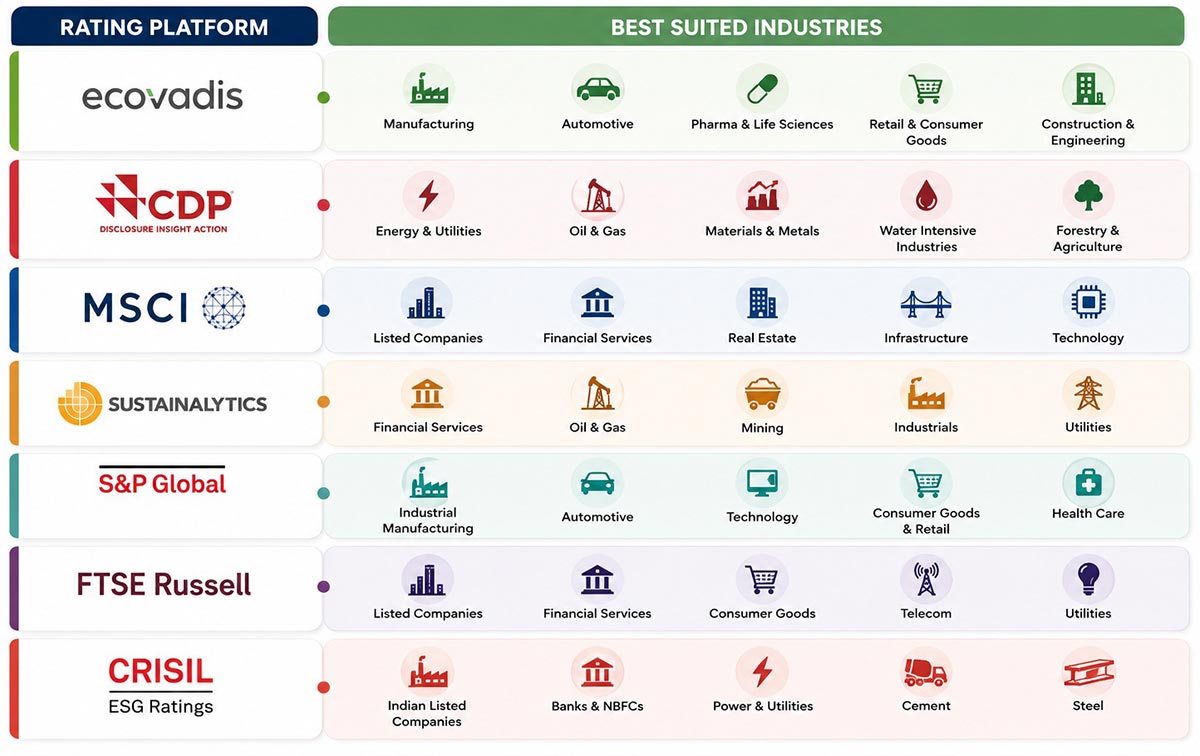
Think of ESG rating platforms as seven different specialists, each called in to assess a different part of the same patientwhich is your company. A cardiologist and a dermatologist will both examine you, but they are looking for very different things and neither replaces the other.
- EcoVadis wants to know how our sustainability management system actually works.This is a kind of thing our procurement teams care about.
- CDP is obsessed with climate and environmental disclosure. Our Investors and customers watch for climate credibility through this platform.
- MSCI ESG Ratings looks purely at what is financially material and the risks and opportunities that could move our valuation.
- Morningstar Sustainalytics measures unmanaged ESG risk and here, what could still hurt us that nobody’s watching.
- S&P Global CSA goes deep and industry-specific hence the platform investors use to benchmark us against true peers.
- FTSE Russell feeds into indices and is mostly a language spoken by global capital markets.
- CRISIL ESG Ratings is the India-specific voice, tightly linked to BRSR and domestic capital markets.
None of them is “the” ESG score. They are seven angles on the same picture. This is the reason why chasing one at a time, in isolation, rarely works.
What Real-World Research Says About This
This isnot just an analogy.It is a documented, measured phenomenon. MIT Sloan’s Sustainability Initiative ran the numbers across the major ESG rating agencies and found something striking: the correlation between two well-known credit rating agencies (Moody’s and S&P) is 0.92 — near-total agreement. The correlation between ESG rating agencies scoring the very same companies averages only around 0.61, and can fall as low as 0.38 depending on the pair compared.
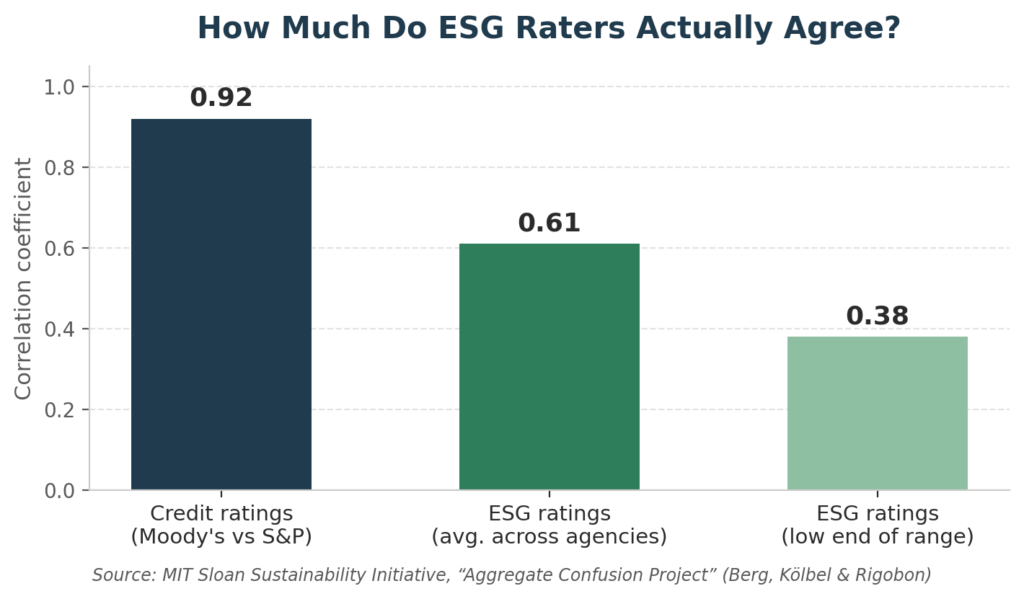
In plain terms: two credit agencies will almost always agree on whether a company is a safe bet. Two ESG agencies scoring the same company often would not agree on whether it is a leader or a laggard.
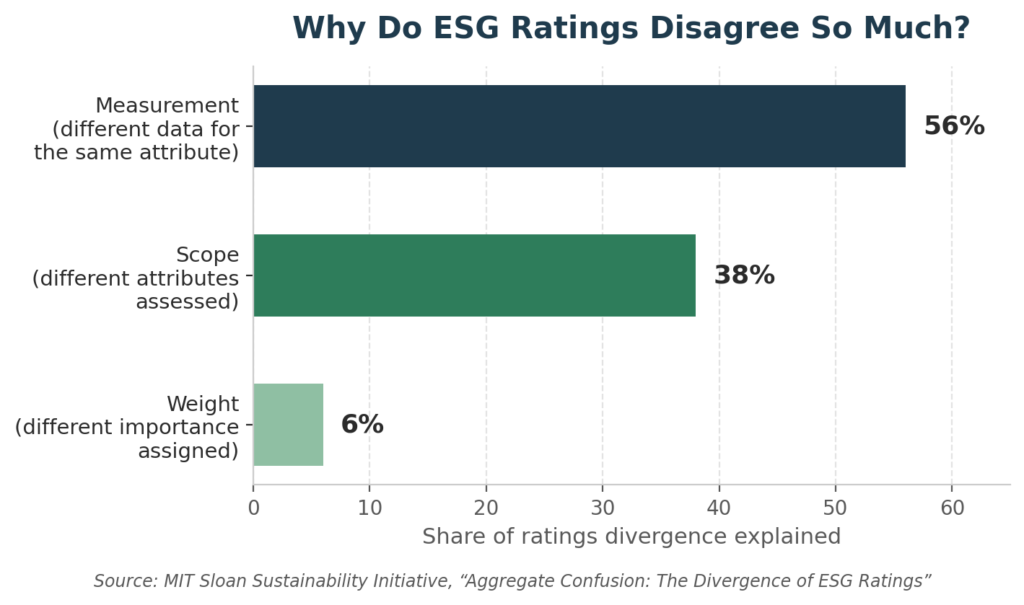
Fiftysix percent of the disagreement comes down to measurement because agencies using different raw data to assess the same attribute. Thirtyeight percent comes from scope, as agencies simply looking at different things. Only 6% comes from genuinely different views on what matters (weighting).
The practical takeaway: your company can look strong to one rater and average to another, purely because of what data each one happened to pull.it is not because of your underlying performance changed. That’s exactly why one clean, well evidenced ESG data system that feeds every platform consistently is worth more than chasing any single score.
1. EcoVadis — The One Our Customers Actually Read
If your company sells into large multinational supply chains, EcoVadis is probably already on your radar, whether you asked for it or not. It scrutinises four areas: Environment, Labour & Human Rights, Ethics, and Sustainable Procurement.Astrong EcoVadis score quietly becomes a business-development tool and proof to a customer’s procurement team that you run a credible, well-governed operation. Global suppliers, manufacturers, automotive vendors and IT/ITES companies selling to multinationals all find this one highly relevant.
EcoVadis is documentation-hungry. Good practices that exist but are not evidenced often donot get credit, and its scoring methodology tends to shift between assessment cycles, so this isnot a submit-once-and-forget exercise.
2. CDP — Turning Emissions Data into Business Credibility
CDP is where climate change, water security and environmental disclosure get formalised. If your business has a meaningful environmental footprint or your customers and investors are asking climate questions.This is the platform that structures your answer.CDP pushes management past simply measuring emissions toward actually understanding climate risk, setting targets, and managing it the way you had to manage any other business risk. It is especially relevant for large listed companies, energy-intensive businesses and anyone exposed to water stress.
Agood CDP disclosure doesnot automatically mean good underlying performance.It measures how well you disclose, not just how well you perform.
3. MSCI — Seeing Our Company Through an Investor’s Eyes
MSCI ESG Ratings ask one focused question: which ESG issues could actually move this company’s financial performance? It scores companies from AAA to CCC, relative to industry peers.MSCI-style assessments shift the conversation in the boardroom from “how did our ESG report look?” to “which of these risks could genuinely hit enterprise value?” It is most relevant for listed companies and anyone courting international capitaland admittedly less useful as a day-to-day operational checklist for private SMEs.
-
Morningstar Sustainalytics — The Risk You Haven’t Managed Yet
Where MSCI asks “what is material,” Sustainalytics asks a sharper question: how much ESG risk is sitting unmanaged on your books right now?This is pure risk visibility which exposures exist, who owns them, what controls are in place, and where investment is genuinely needed. It is most relevant to listed and financialmarketfacing companies, though a lower risk score doesnot automatically mean sustainability leadership.It just means fewer landmines.
-
S&P Global CSA — The Deep, Industry-Specific Benchmark
This is the most detailed and resourceintensive assessment of the group, a genuinely granular, sector-specific look at ESG performance, best known as the engine behind the Dow Jones Sustainability Index.It lets management move from vague “we are doing okay on ESG” statements to precise, competitive benchmarking against the best performers in the sector. It rewards large, multinational or industrial companies with the resources to participate meaningfully; early-stage SMEs will likely find it heavy going.
-
FTSE Russell — The Index Investor’s Yardstick
FTSE Russell scores ESG exposure and performance in a structured, quantitative way, and feeds directly into how global indices and investors view a company. It leans heavily on what is publicly disclosed so disclosure gaps here translate directly into visibility gaps. Most relevant for listed and internationally traded companies; less useful as an internal management tool
7.CRISIL ESG Ratings — The One That Matters at Home
For Indian companies especially listed ones, CRISIL deserves its own attention. CRISIL ESG Ratings & Analytics is registered with SEBI as a Category, ESG rating provider, and its methodology incorporates a double-materiality lens (how ESG affects the company, and how the company affects the world).
It is tightly woven into the BRSR ecosystem. The message here is simple that BRSR isnot a once-a-year reporting exercise anymore. The quality, controls and assurance behind that data increasingly matter to external stakeholders, and CRISIL is where that scrutiny shows up first.
So Which Rating Should You Actually Chase?
It depends entirely on what business outcome you’re solving for:
| If your goal is to… | The platform that matters most is… |
| Win or retain multinational customers | EcoVadis |
| Improve climate credibility | CDP |
| Demonstrate investor-grade ESG resilience | MSCI |
| Understand unmanaged ESG risk | Sustainalytics |
| Benchmark against global peers | S&P Global CSA |
| Strengthen investor/index positioning | FTSE Russell |
| Strengthen Indian ESG positioning | CRISIL |
The good news: these aren’t seven separate homework assignments. GHG data, water data, governance information, supplier practices and social metrics overlap heavily across all of them. Once you see the overlap, the workload shrinks dramatically.
The Expensive Mistake: Building Multiple ESG Systems for All Rating Platforms
This is where companies routinely lose money and patience.They build a separate team, spreadsheet and process for every single rating. One group preps EcoVadis. Another handles CDP. A third owns BRSR. A fourth fields customer questionnaires. Nobody talks to anybody else.The result is duplicate work, inconsistent numbers across submissions, exhausted teams, and rising costsfor essentially the same underlying data, formatted seven different ways.
The fix is one sentence long: build one ESG management system that feeds multiple external ratings — not the other way around.
How to Actually Build That System
Picture it as five stacked layers, each one supporting the next:
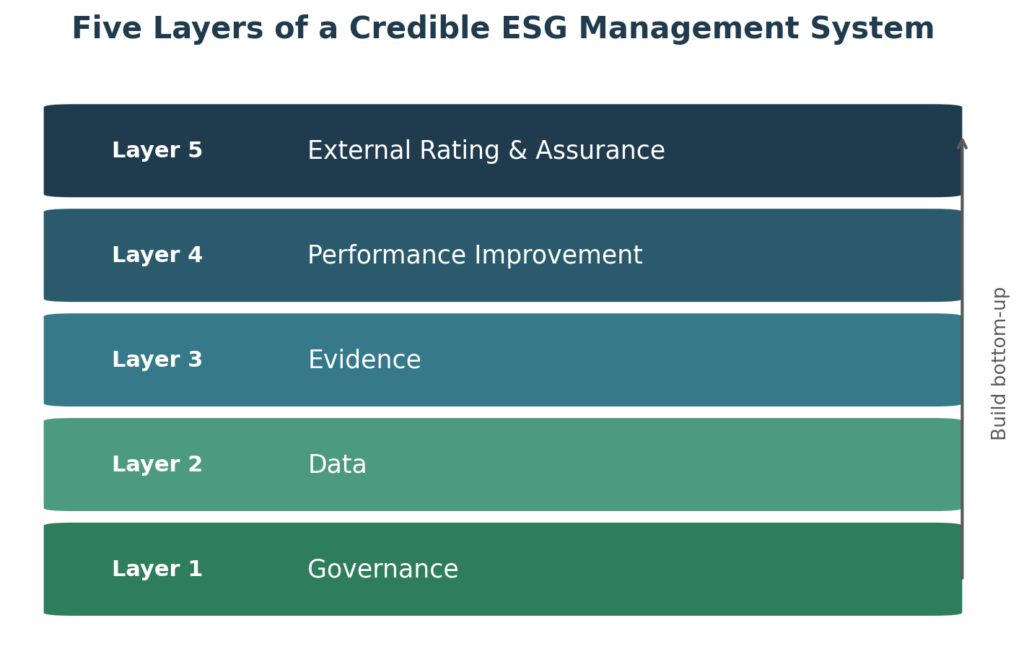
Layer 1 — Governance. A clear chain of accountability: Board → ESG/Sustainability Committee → Management → Functional Owners, each responsible for a specific areas like climate, water, energy, waste, people, supply chain, ethics and risk.
Layer 2 — Data. One controlled data architecture, not seven scattered ones, covering everything from Scope 1–3 emissions to workforce diversity, safety, human rights, supplier practices and cybersecurity.
Layer 3 — Evidence. Every ESG claim needs a paper trail: Policy → Approval → Implementation → KPI → Target → Performance → Audit/Assurance. If you do not have evidence, a rating platform would not credit it.
Layer 4 — Performance improvement. The whole point of measuring is to actually improve water, energy, carbon, waste, supply chain, not just to report a number.
Layer 5 — External rating & assurance. Only once the first four layers are solid should the focus shift outward: Measure → Control → Improve → Assure → Disclose → Benchmark → Improve again.
Skipping straight to Layer 5 without the foundation underneath is exactly how companies end up scrambling every rating cycle.
What This Means in the Boardroom
The Board’s job here isnot to review individual questionnaire answers. Its job is to ask the questions that connect ESG ratings back to enterprise value:
- Are our ESG risks increasing or decreasing?
- How do we compare with competitors?
- Are customers demanding higher ESG performance or are we losing business over gaps?
- Are our sustainability investments actually generating a return?
- Are emissions and resource costs coming down?
- Are our disclosures reliable enough to trust?
- Are we ready for the regulation and market expectations coming next?
Answer those seven, and the individual platform scores start to explain themselves.
Treat It Like an Investment, Not a Compliance Cost
| Where you invest | What it actually buys you |
| Internal resources | Faster ownership and response |
| ESG data systems | Reliable, reusable data |
| Consulting & technical support | Faster gap closure |
| Assurance | Real credibility |
| Training | Cross-functional ownership |
| Improvement projects | Cost savings and emissions/resource reductions |
| External ratings | Customer, investor and market positioning |
A Realistic 12-Month Roadmap
You don’t need to fix everything in month one. A sensible sequence looks like this:
Months 1–3: Assess which ratings are commercially relevant, run a materiality and gap assessment, and identify priority risks.
Months 3–6: Establish governance and ownership, and start building a single ESG data architecture, Start with one source of truth instead of seven.
Months 4–8: Build an evidence repository, and run GHG, water, energy, waste and social assessments to set a real performance baseline.
Months 6–10: Launch improvement projects, close rating-specific gaps, and generate measurable results.
Months 9–12: Strengthen assurance, complete management review, and make external submissions with confidence.
Month 12 onward: this isn’t a one-time project.It has become a continuous improvement cycle.
The Real Big Picture
Here is the logic chain that ties all of this together:
Stakeholder expectations → material ESG risks & opportunities → ESG data & evidence → performance improvement → assurance & controls → external ratings → customer / investor / lender confidence → business value.
Notice where the “rating” sits in that chain. It will be near the end, not the beginning. The score isnot the goal. It is the natural byproduct of running the business well.
Don’t Chase the Score. Build the System.
The ESG ratings landscape will keep shifting.New methodologies, new investor questions, new customer requirements and cannot deny the tightening regulation. Companies that respond by building a fresh process for every new questionnaire will keep paying more for less. Companies that build one credible, well-governed ESG system will simply plug new requirements into what already exists.
The formula, in short:
One data architecture + one evidence framework + one governance system + one improvement roadmap = multiple rating outcomes.
For management, that means better decisions, lower risk and stronger customer relationships. For the Board, it means real visibility into sustainability-linked enterprise risk. For the business as a whole, it means competitiveness, resilience and better access to markets and capital.
So the real question isnot “What rating will we get?”
It’s: “What will our business be worth and how resilient will it be — if we actually build the ESG capabilities which the market is already expecting of us?”