Business Responsibility and Sustainability Reporting (BRSR): More Than Just a Compliance Requirement
For many listed companies in India, preparing a Business Responsibility and Sustainability Report (BRSR) is no longer the most difficult part of the process. The real challenge begins much earlier—collecting reliable ESG data, validating it across multiple business functions, and ensuring every disclosure is supported by documented evidence.
In many organizations, environmental data is maintained by the EHS team, workforce information by Human Resources, governance records by the Company Secretarial function, supplier information by Procurement, and operational metrics by different business units. Bringing all this information together into one transparent, consistent, and audit-ready report often requires far more effort than writing the report itself.
This is why many organizations discover that BRSR is not simply an annual reporting exercise—it is a company-wide management process.
Rather than viewing BRSR as another compliance obligation, forward-looking organizations are integrating ESG reporting into their core business strategy. The result is better data quality, stronger stakeholder trust, improved readiness for ESG assurance, and greater resilience in an increasingly sustainability-focused business environment.
This explains not only what BRSR is, but also how successful organizations implement it, where companies commonly struggle, and what practical steps can help build a reliable ESG reporting system.
What is Business Responsibility and Sustainability Reporting (BRSR)?
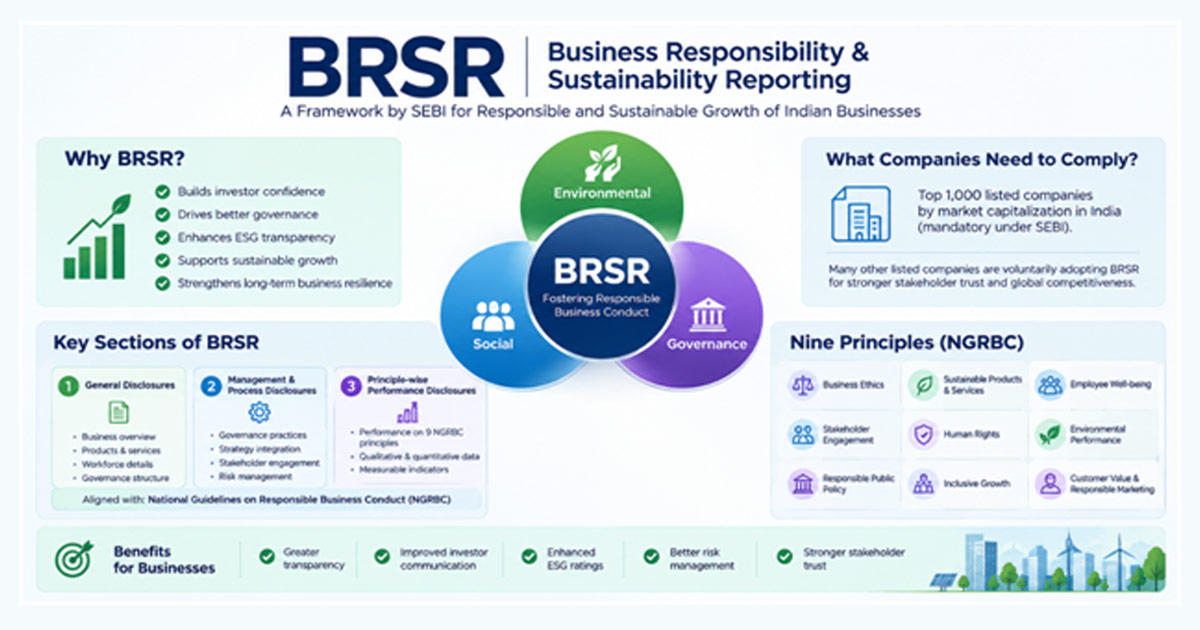
Business Responsibility and Sustainability Reporting (BRSR) is India’s standardized Environmental, Social, and Governance (ESG) disclosure framework developed by the Securities and Exchange Board of India (SEBI). It enables listed companies to communicate how they manage sustainability-related risks, opportunities, governance practices, and business impacts in a structured, transparent, and comparable manner.
Investors, analysts, regulators, lenders, and other stakeholders can now evaluate companies using a common reporting framework.
BRSR is built around the National Guidelines on Responsible Business Conduct (NGRBC), which outline nine principles that encourage organizations to operate responsibly, ethically, and sustainably while creating long-term value for society and the economy.
The framework covers a broad range of topics, including:
- Business ethics and corporate governance
- Environmental management
- Climate-related performance
- Employee health, safety, and well-being
- Human rights
- Diversity and inclusion
- Responsible supply chain management
- Customer responsibility
- Community engagement
- Sustainable products and services
In simple terms, BRSR answers an important question:
How responsibly does a company operate beyond its financial performance?
Why Did SEBI Introduce BRSR?
Over the past decade, investors have increasingly recognized that financial performance alone does not provide a complete picture of a company’s long-term resilience. Climate change, resource availability, workforce practices, governance failures, supply-chain risks, and stakeholder expectations can all influence business performance and enterprise value.
Global investors now routinely assess ESG performance before making investment decisions. Similarly, lenders, customers, multinational corporations, and rating agencies increasingly evaluate organizations based on sustainability-related information.
Recognizing this shift, SEBI introduced BRSR to improve the quality, consistency, and comparability of ESG disclosures among Indian listed companies.
Which Companies Need to Comply with BRSR?
SEBI has made BRSR reporting mandatory for the top 1,000 listed companies in India by market capitalization, requiring them to include BRSR disclosures as part of their Annual Report.
Why BRSR Matters More Than Ever
A common misconception is that BRSR exists primarily to satisfy regulatory requirements.In reality, high-quality ESG reporting delivers business value across multiple functions.
Reliable sustainability data enables leadership teams to make informed strategic decisions. Investors gain greater confidence in the company’s governance and long-term resilience. Customers increasingly prefer suppliers that can demonstrate responsible business practices. Lenders may also consider ESG performance when assessing long-term risks.
For example, organizations frequently discover that:
- Energy consumption data is recorded differently across facilities.
- Water withdrawal information lacks consistent measurement.
- Supplier ESG information is incomplete or unavailable.
- Workforce diversity metrics are not centrally maintained.
- Governance records exist but are not documented in a report-ready format.
Addressing these gaps strengthens not only reporting quality but also the organization’s management systems.
BRSR Is Becoming a Strategic Business Tool
Organizations that derive the greatest value from BRSR are those that integrate ESG data into routine business processes instead of collecting it only a few weeks before publishing the Annual Report.
When ESG information is managed throughout the year, companies can:
- Track sustainability performance more effectively.
- Identify emerging operational risks earlier.
- Improve board-level decision-making.
- Respond more efficiently to investor ESG questionnaires.
- Prepare for external ESG assurance.
- Reduce year-end reporting pressure.
- Strengthen stakeholder confidence.
In practice, organizations often spend far more time collecting, validating, and reconciling ESG information than actually writing the report. This highlights an important reality: strong BRSR reports are built on strong management systems, not simply good report writing.
How a BRSR Project Actually Works Inside an Organization
One of the biggest misconceptions about BRSR is that it is owned by a single department. In reality, preparing a high-quality Business Responsibility and Sustainability Report is a cross-functional exercise involving multiple teams, each responsible for different aspects of ESG performance.
For example:
| Department | Typical Contribution |
| EHS / Sustainability | Energy, emissions, water, waste, environmental compliance, climate initiatives |
| Human Resources | Workforce demographics, diversity, employee well-being, training, health & safety, grievances |
| Procurement | Supplier assessment, responsible sourcing, vendor ESG information |
| Company Secretarial / Legal | Governance disclosures, Board composition, ethics, compliance, policies |
| CSR Team | Community investments, social impact programmes |
| Finance | Operational data validation, business performance, assurance support |
| Operations / Manufacturing | Resource consumption, production data, environmental performance |
| Quality | Product responsibility, customer satisfaction, complaints, recalls |
| IT / Digital | Data management systems, reporting platforms, cybersecurity (where applicable) |
Although one department often coordinates the report, no single function owns all the required information. This makes collaboration essential.
A successful BRSR report depends not only on collecting data but also on establishing clear ownership, timelines, review mechanisms, and internal validation before information is disclosed publicly.
Why Many Companies Struggle with BRSR Despite Understanding the Framework
Most organizations understand what SEBI expects. The challenge lies in implementing those expectations consistently across the business.
Through ESG reporting engagements, several recurring issues are observed.
- ESG Data Is Scattered Across Multiple Departments
Unlike financial Most organizations understand SEBI’s BRSR requirements. The real challenge is implementing them consistently across the organization. Based on our ESG reporting experience, the following challenges are commonly observed:
- ESG Data Is Spread Across Departments
ESG data is usually maintained by different functions such as EHS, HR, Procurement, Finance, and the Company Secretarial team. Consolidating information from multiple locations and formats into a single, reliable dataset requires significant coordination. - Unclear Data Ownership
Many organizations struggle to identify who is responsible for specific BRSR disclosures. Without clearly defined data owners, collecting accurate information becomes difficult and delays the reporting process. - Lack of Supporting Evidence
Reliable ESG reporting requires supporting documents such as utility bills, energy and water records, waste manifests, HR records, training logs, policies, board minutes, and compliance certificates. Without proper evidence, even accurate data can lose credibility. - Last-Minute Data Collection
Many companies begin collecting ESG data only when the Annual Report is being prepared. This often leads to missing information, inconsistent data, limited review time, and avoidable reporting errors. Collecting data throughout the year significantly improves reporting quality. - Limited Supplier ESG Information
Several BRSR disclosures require information from suppliers and the value chain. However, many suppliers do not monitor ESG data or have formal reporting systems, making data collection challenging. - Policies Exist, but Implementation Is Limited
Most organizations have policies on areas such as ethics, environment, health and safety, human rights, and anti-bribery. However, BRSR focuses on how effectively these policies are implemented, monitored, and demonstrated in practice. - ESG Is Treated as an EHS Function
A common misconception is that BRSR is solely the responsibility of the EHS team. In reality, successful reporting requires active participation from leadership and multiple functions, including HR, Procurement, Finance, Operations, Legal, and Corporate Governance.
Where Companies Commonly Make Mistakes
Even organizations with well-established sustainability programmes face challenges while preparing BRSR reports. Some of the most common mistakes include:
- Reporting data without proper supporting evidence, making it difficult to validate disclosures during reviews or assurance.
- Treating CSR and ESG as the same, whereas BRSR covers a much broader range of environmental, social, and governance topics.
- Starting data collection only at the end of the financial year, resulting in missing information, tight timelines, and avoidable errors.
- Trying to report everything instead of focusing on material ESG issues that are most relevant to the business and its stakeholders.
- Using different reporting approaches across sites or business units, which leads to inconsistent data and reduces comparability.
Lessons We’ve Learned from Supporting ESG Reporting Projects
Although every organization is different, several practical lessons consistently emerge from ESG reporting engagements.
Start Early
The quality of a BRSR report depends far more on preparation than on writing. Organizations that collect data throughout the year experience fewer reporting delays and produce more reliable disclosures.
Assign Clear Ownership
Every disclosure should have a designated owner responsible for data collection, validation, and approval. This reduces confusion and accelerates the reporting process.
Build Evidence Alongside Data
Every ESG metric should be supported by verifiable documentation. Strong evidence simplifies internal reviews, investor queries, and future assurance activities.
Standardize Reporting Across Locations
Using common templates, definitions, and reporting frequencies ensures consistency across business units and makes year-on-year comparisons more meaningful.
Engage Leadership Early
When boards and senior management actively oversee ESG performance, sustainability initiatives are more likely to receive the resources and cross-functional collaboration needed for successful implementation.
Expert Insight
One observation consistently seen across ESG reporting projects is that preparing the report itself represents only a small portion of the overall effort. In practice, organizations often spend just 15–20% of the project drafting the BRSR report, while nearly 80–85% of the time is dedicated to collecting, validating, reconciling, and reviewing ESG data from across the business.
A significant amount of time is also invested in coordinating with multiple departments, conducting follow-up meetings, resolving data gaps, validating calculations, reviewing supporting evidence, preparing or updating ESG-related policies, obtaining management approvals, and aligning disclosures with SEBI’s reporting requirements. Since ESG information is typically owned by different functions such as EHS, HR, Procurement, Finance, Operations, and CompanySecretarial, effective collaboration is essential to ensure consistency and accuracy.
The organizations that produce the strongest BRSR reports are not necessarily those with the most advanced sustainability programmes. They are the ones that have established disciplined processes for data ownership, cross-functional collaboration, documentation, governance, periodic reviews, and continuous improvement throughout the year rather than treating BRSR as a last-minute reporting exercise.
How Wire Consultancy Helps Organizations Build Reliable BRSR Reporting Systems
Preparing a Business Responsibility and Sustainability Report (BRSR) requires much more than completing a disclosure template. It demands a structured approach to ESG governance, reliable data management, cross-functional coordination, and a clear understanding of SEBI’s reporting expectations.
At Wire Consultancy, we believe that an effective BRSR report should not only meet compliance requirements but also help organizations strengthen internal governance, improve sustainability performance, and build stakeholder confidence.
Our approach is practical, collaborative, and focused on creating long-term value rather than simply delivering a report.
Our BRSR Implementation Methodology
Preparing a Business Responsibility and Sustainability Report (BRSR) is more than completing a disclosure template. It requires strong governance, reliable ESG data, cross-functional collaboration, and a clear understanding of SEBI’s reporting requirements. At Wire Consultancy, our focus is not just on delivering a compliant report but on helping organizations build a structured ESG reporting process that creates long-term value.
Phase 1 – Understand the Business
We begin by understanding the organization’s business, operations, ESG initiatives, stakeholder expectations, and current reporting practices. This helps define the reporting scope and identify key focus areas.
Phase 2 – Gap Assessment
We assess the organization’s existing practices against the BRSR framework to identify gaps in disclosures, policies, data availability, governance, and supporting documentation. The outcome is a practical action plan for closing these gaps.
Phase 3 – Data Collection & Validation
We work closely with teams such as EHS, HR, Procurement, Finance, Operations, and CSR to collect, validate, and organize ESG data. We also help define data owners and ensure that each disclosure is supported by appropriate evidence.
Phase 4 – Materiality Assessment
We identify the ESG topics that are most relevant to the business by considering stakeholder expectations, industry trends, business risks, and regulatory requirements. This ensures the report focuses on the issues that matter most.
Phase 5 – Report Preparation
Based on the validated information, we prepare a clear, accurate, and SEBI-aligned BRSR report, including performance indicators, governance disclosures, sustainability initiatives, and supporting narratives.
Phase 6 – Review & Quality Check
Before finalization, we review the report for data accuracy, consistency, calculations, and supporting evidence. This helps ensure the report is reliable and ready for management review or future assurance.
Phase 7 – Continuous Improvement
BRSR should be an ongoing process rather than a once-a-year exercise. We help organizations establish ESG governance, reporting calendars, KPI tracking, and continuous improvement processes to strengthen sustainability performance year after year.
What Makes Wire Consultancy Different?
Many organizations can prepare a report.
Our focus is helping clients build systems that make reporting easier, more reliable, and more valuable year after year.
Our approach combines:
- ESG reporting expertise
- Sustainability strategy
- Environmental management
- Carbon accounting
- Climate risk assessment
- Water stewardship
- ESG data management
- Governance advisory
- Assurance readiness
This integrated perspective enables clients to move beyond compliance and build mature ESG reporting capabilities.
Typical Timeline for a BRSR Project
While every organization is different, a typical BRSR engagement may follow this timeline:
| Phase | Estimated Duration |
| Kick-off and Planning | 1 week |
| Gap Assessment | 2weeks |
| ESG Data Collection | 3 weeks |
| Validation and Review | 1 weeks |
| Report Preparation | 2–3 weeks |
| Final Review and Management Approval | 1weeks |
The timeline depends on factors such as the number of business locations, data availability, reporting maturity, and responsiveness of internal teams.
Common Questions We Receive from Clients
During initial discussions, clients often ask practical questions rather than regulatory ones.
Some of the most common include:
- How long will the project take?
- Which departments need to be involved?
- Do we need new ESG software?
- Can we prepare BRSR using existing systems?
- What evidence should we maintain?
- Should ESG data be externally assured?
- How do we improve ESG ratings?
- Can BRSR be integrated with GRI or other sustainability frameworks?
- How much internal effort will be required?
These questions reflect the reality that organizations are looking for implementation guidance—not just regulatory interpretation.
Why Organizations Choose Wire Consultancy
Organizations choose Wire Consultancy because they want more than a completed report.
They want a partner who can help them:
- Build practical ESG governance systems.
- Improve data quality.
- Strengthen internal coordination.
- Simplify complex reporting requirements.
- Prepare for future assurance expectations.
- Develop long-term sustainability strategies.
Our consultants work alongside client teams, transferring knowledge throughout the engagement so that organizations become increasingly self-sufficient over time.