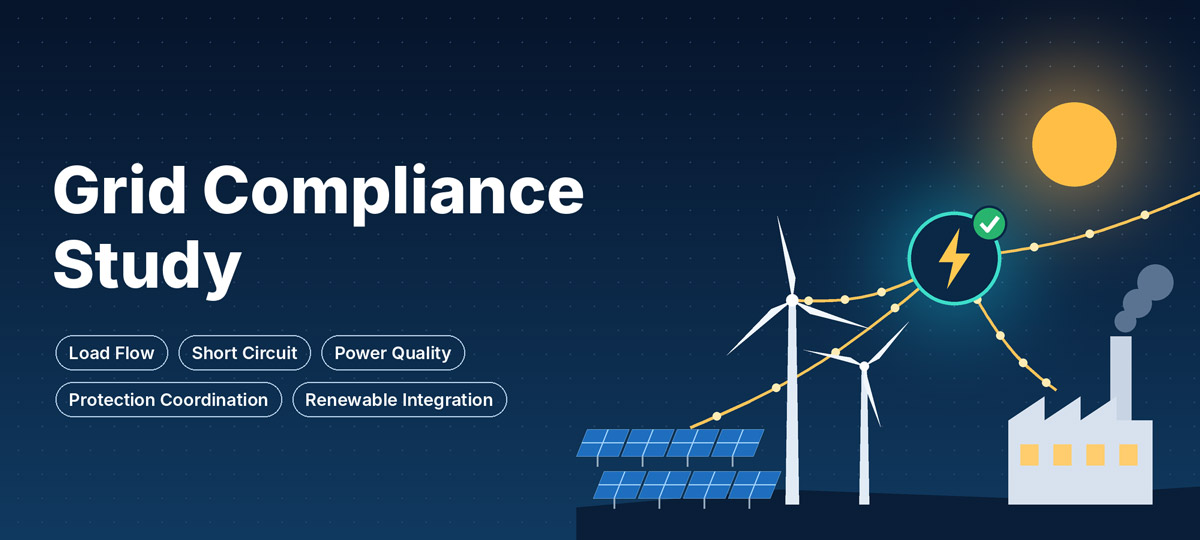
India is adding solar and wind capacity at a record pace, while new and expanding industrial plants continue to place greater demand on the power network. Every one of these projects must connect to a grid that is expected to remain stable, safe and reliable.
But connecting a plant to the electricity grid involves far more than installing transformers, switchgear and transmission lines. Before a project can operate reliably, its electrical system must demonstrate that it will not adversely affect the grid.
This is the role of a Grid Compliance Study.
A Grid Compliance Study is a technical assessment of an electrical facility’s interaction with the existing power network.
It evaluates whether a power plant or industrial facility can operate safely and reliably while meeting applicable technical standards, grid codes and connectivity requirements. India’s framework includes the CERC Indian Electricity Grid Code (IEGC), 2023 and the CEA Technical Standards for Connectivity to the Grid, along with applicable procedures and requirements of the concerned transmission or distribution utility.
For project developers, the study is not simply a regulatory document. It is an engineering tool that can identify problems before they become commissioning delays or expensive modifications.
What Does a Grid Compliance Study Cover?
The exact scope depends on the project, point of interconnection, voltage level, technology and applicable utility requirements. However, a comprehensive study can involve several electrical-system assessments.
At a glance: Typical studies include
| Steady-state | Faults & protection | Power quality | Dynamic behaviour | Models & compliance | ||||
| 01 Load flow analysis
02 Reactive power & voltage control 03 Power factor assessment |
04 Short-circuit analysis
05 Relay coordination |
06 Harmonic analysis
07 Power quality assessment |
08 Transient & dynamic studies
09 Fault ride-through (where applicable) 10 Grid disturbance & stability |
11 Generator / inverter model validation
12 Compliance vs. applicable grid requirements |
||||
| Exact scope depends on the project, point of interconnection, voltage level, technology and utility requirements. | ||||||||
The CERC IEGC 2023 specifically introduced or strengthened provisions covering protection, monitoring and compliance, commissioning and commercial operation, including provisions relevant to wind, solar, hybrid, pumped-storage and energy-storage stations.
- Grid Compliance for Solar Power Plants
Solar plants are increasingly connected at high-voltage substations and can have a significant impact on grid voltage and power quality.
Solar plants experience changing generation depending on solar irradiation. A solar plant’s inverter-based generation behaves differently from a conventional synchronous generator. Consequently, the study needs appropriate inverter characteristics and models rather than simply treating the plant as a conventional generator.
Example
Consider a 100 MW solar power plant connected to a 220 kV Grid.
The grid compliance study assesses inverter performance, reactive power capability, harmonics and power evacuation. Suppose it shows that the voltage at the point of interconnection rises beyond the acceptable operating range.
The project may then need to evaluate reactive-power control, transformer tap settings, STATCOM/SVC support or other voltage-management measures.
Without the study, the issue may only become apparent during commissioning or utility review.
- Grid Compliance for Wind Power Plants
Wind farms present similar but distinct challenges because generation changes with wind conditions.
Rapid changes in active power, reactive-power behavior and voltage interaction can affect the connected network. Large wind projects may therefore require detailed modelling and assessment of their response under different operating conditions.
The CEA’s Grid Management Division continues to publish material concerning compliance with technical connectivity standards and has specifically addressed compliance matters involving renewable-energy projects and wind power plants.
Example
Imagine a 250 MW wind farm connected to a 400 kV transmission network.
At low wind speed, generation may be significantly below rated capacity. At high wind speed, the plant approaches maximum export.
The grid study evaluates both conditions and checks whether voltage, reactive power, transformer loading and other parameters remain in acceptablerange.
If the plant’s reactive-power capability is inadequate at one operating point, corrective measures can be identified before commissioning.
- Grid Compliance for Industrial Plants
Grid compliance is not limited to generating stations.
Large industrial facilities can significantly influence the network because of high-capacity motors, furnaces, variable-frequency drives, compressors, UPS systems, captive generators and other nonlinear or dynamic loads.
For an industrial plant, the study may focus heavily on:
- Voltage fluctuations
- Harmonics
- Power factor
- Motor starting
- Short-circuit levels
- Protection coordination
- Load flow
- Reactive power
- Captive generation
- Grid disturbance response
Example
A manufacturing plant installs a 30 MW electric furnace while expanding its production line.
The new equipment significantly changes the facility’s electrical demand and may introduce harmonic distortion and voltage fluctuations.
A Grid Compliance Study can assess the impact before the equipment is fully commissioned and determine whether harmonic filters, reactive-power compensation or other measures are required.
- Load Flow Analysis: Understanding How Power Moves
Load flow is one of the foundations of grid studies.
Load Flow Analysis determines how electrical power flows through the network under different operating conditions.
It evaluates voltage profiles, active and reactive power flow, transformer and transmission line loading, and system losses.
For example:
Solar plant:Assesses voltage rise, power evacuation and inverter reactive power exchange.
Wind farm:Evaluates collector network loading, voltage profiles and power evacuation.
Industrial facility:Examines load distribution, transformer loading, voltage drops and reactive power demandunder different conditions such as minimum load, normal production and maximum demand.
- Short-Circuit Study: What Happens During a Fault?
A fault can cause extremely high currents within milliseconds.
Short-circuit analysis determines prospective fault levels at important buses and helps verify whether switchgear and other equipment have adequate interrupting and withstand capabilities.
It helps verify whether circuit breakers, transformers, switchgear and other equipment can safely withstand and interrupt fault currents.
It also provides essential information for protection-system design.
Example
If a new generator increases the calculated fault level at a 33 kV bus beyond the rating of existing switchgear, the project has a serious engineering issue.
Identifying this during the study is considerably better than discovering it after commissioning.
- Harmonic and Power Quality Assessment
Power electronic equipment is becoming increasingly common in solar plants, wind farms, energy storage systems and industrial facilities (VFDs, UPS systems and converters), and it can contribute to harmonic distortion in the system.
A Grid Compliance Study can determine whether harmonic levels at the relevant point of interconnection remain within applicable limits and whether mitigation measures are necessary.
CEA’s recent grid-management activities also show continued attention to issues such as harmonic filters and technical compliance for renewable-energy connections.
- Protection Coordination and Grid Security
A technically compliant plant also needs a properly coordinated protection system.
Relay settings should coordinate with upstream and downstream protection so that faults are isolated selectively without unnecessarily disconnecting healthy portions of the grid.
This can involve generator, transformer, feeder, busbar and interface protection.
The IEGC 2023 includes a dedicated Protection Code covering protection protocols, settings and protection audit planning.
- Reactive Power and Voltage Control Assessment
This assessment evaluates the facility’s ability to maintain voltage within permissible limits by managing reactive power.
It examines inverter capabilities, power factor, capacitor banks, reactors and transformer tap changer requirements.
- Dynamic Studies and Renewable Integration
For large renewable and inverter-based projects, steady-state analysis may not provide the complete picture.
Dynamic studies can evaluate how the plant responds to disturbances such as voltage dips, faults or changes in grid conditions.
This is particularly important where the project has substantial generation capacity relative to the strength of the connected network.
- Fault Ride-Through Assessment
Fault Ride-Through assessment evaluates whether renewable generating plants can remain connected during specified grid voltage disturbances.
It generally covers Low Voltage Ride Through (LVRT), High Voltage Ride Through (HVRT), inverter response and post-fault power recovery, as applicable.
- Compliance Is More Than One Report
A common mistake is treating a Grid Compliance Studyas a single calculation.
Every link must match
| 1
Approved SLD |
› | 2
Equipment data |
› | 3
Simulation model |
› | 4
Engineering studies |
› | 5
Protection settings |
› | 6
Test results |
› | 7
Final compliance docs |
| If any link doesn’t match, utilities may raise technical observations or request revised studies. | ||||||||||||
The CEA connectivity framework places responsibility on the requester/user for planning, design, reliability, protection and safe operation of its equipment and requires relevant technical data and operational information for grid interconnection.
Why Conduct the Study Before Commissioning?
A pre-commissioning Grid Compliance Study gives project owners an opportunity to identify technical problems before the utility identifies them.
Pre-commissioning checklist
| Question | Answered by | |
| ☐ | Can the plant export or import power safely? | Load flow |
| ☐ | Are voltage levels acceptable? | Load flow |
| ☐ | Are transformers and lines adequately rated? | Load flow |
| ☐ | Are fault levels within equipment ratings? | Short circuit |
| ☐ | Are protection systems coordinated? | Relay coordination |
| ☐ | Are harmonics within applicable limits? | Harmonic analysis |
| ☐ | Can reactive-power requirements be achieved? | Reactive power |
| ☐ | Does the plant respond appropriately to grid disturbances? | Dynamic / FRT |
| ☐ | Is the simulation model representative of the final installation? | Model validation |
These questions become increasingly important as India’s grid incorporates larger quantities of renewable and inverter-based generation.
Regulatory Framework for Grid Compliance in India
Grid-connected facilities in India must comply with the technical and regulatory requirements applicable to their project, connection voltage and point of interconnection.
The key regulatory references may include:
- Indian Electricity Grid Code (IEGC), 2023, and applicable amendments.
- CEA (Grid Standards) Regulations, 2010, and applicable amendments.
- CEA Technical Standards for Connectivity.
- CERC Connectivity and General Network Access Regulations.
- Relevant State Grid Codes and applicable CTU, STU, RPC, SLDC and RLDC requirements.
The specific requirements depend on the type, capacity and connectivity arrangement of the facility.
How Wire Consultancy Can Help
At Wire Consultancy, we provide specialized power system engineeringconsultancy and grid compliance solutions forsolar plants, wind farms, industrial facilities, captive power projects and other grid-connected installations.
The scope can be tailored to the project’s voltage level, technology, capacity and point of interconnection. However, for a comprehensive study, our approach combines detailed network modelling, engineering simulations and technical assessments to identify potential system constraints and recommend practical solutions.
Our key engineering services include:
- Load Flow Analysis
- Short-Circuit Studies
- Reactive Power and Voltage Control Assessment
- Harmonic Analysis
- Dynamic Stability Studies
- Fault Ride-Through Assessment
- Protection Coordination and Relay Setting Review
- Grid Compliance and Technical Reporting
The objective is straightforward: identify grid-integration risks early, demonstrate technical compliance and help project owners approach utility approvals and commissioning with a technically defensible engineering package.
For a solar park, wind farm or large industrial facility, grid compliance should not be treated as the final paperwork before energization. It should be an engineering requirement considered from the early design stage through commissioning and operation.