The Hidden Threat Impacting Performance, Safety, and Financial Stability
As India accelerates its transition toward renewable energy, vast solar parks and wind farms are rapidly transforming open landscapes across the country. From Rajasthan’s large-scale solar installations to wind corridors in Gujarat and Tamil Nadu, the shift is visible—and necessary.
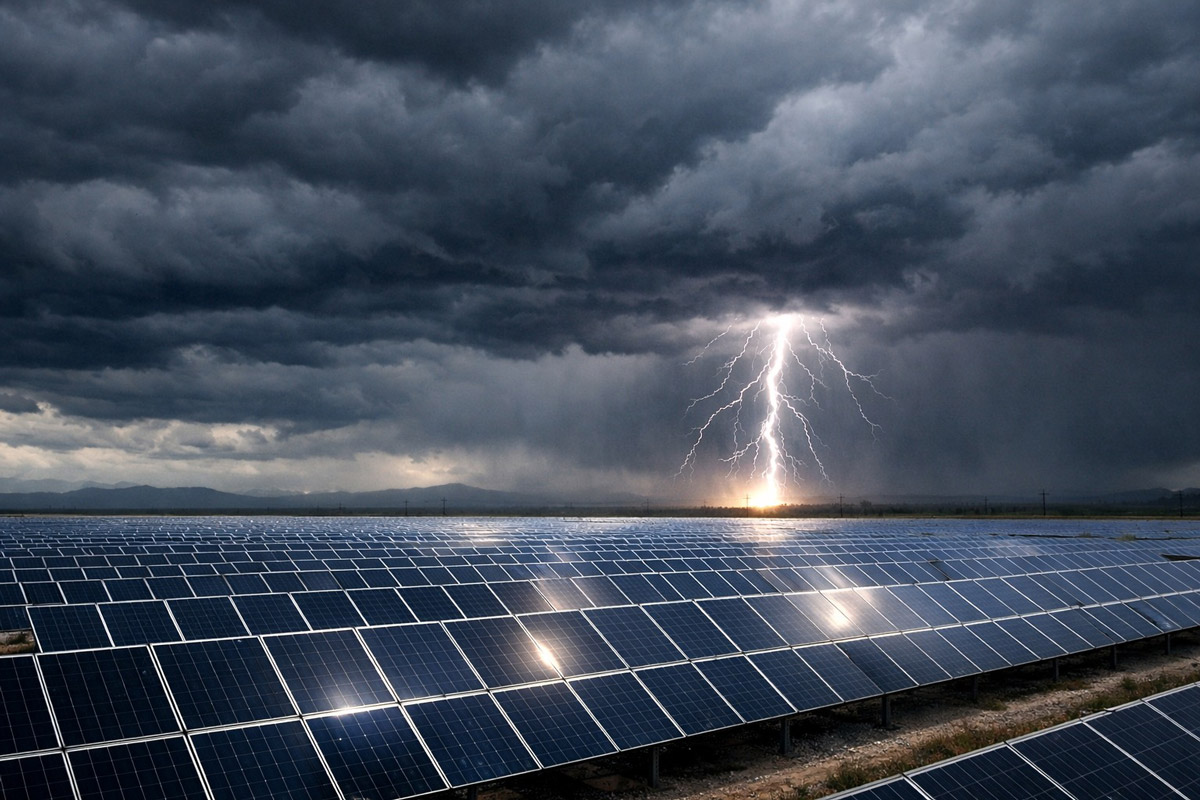
But alongside this growth lies an often underestimated risk: lightning.
While solar and renewable plants are designed for efficiency and sustainability, they are also uniquely exposed to natural elements. Among these, lightning remains one of the most unpredictable and damaging threats. Despite this, many projects still overlook a structured Lightning Risk Assessment (LRA) during planning and execution stages.
A Growing Concern in Renewable Infrastructure
Unlike conventional power plants, renewable energy installations are typically spread over large, open areas. Solar panels are installed across acres of land with minimal vertical shielding, while wind turbines stand tall as natural lightning attractors.
This combination creates a high-risk environment.
Industry observations show that lightning-related failures are not rare. In fact, many solar plants experience recurring issues such as inverter breakdowns, communication failures, and unexplained system trips during storm seasons. These incidents often go unreported as lightning-related damage, leading to repeated operational inefficiencies.
What Exactly is Lightning Risk Assessment?
Lightning Risk Assessment is not just a theoretical calculation—it is a structured engineering study designed to quantify risk.
Based on standards like IEC 62305:2024, the assessment evaluates:
- The probability of lightning strikes in a specific location
- The vulnerability of structures and equipment
- The potential impact on human safety, operations, and assets
The outcome is a clear recommendation: whether protection is needed, and if so, how much.
This is critical because lightning protection is not a one-size-fits-all solution. Overdesign increases costs unnecessarily, while underdesign leaves the plant exposed.
Why Renewable Plants Are More Vulnerable
The vulnerability of renewable plants is not accidental—it is inherent in their design and location.
Open Terrain Exposure
Solar plants are usually built in open, flat regions where there are no natural barriers to lightning strikes.
Height and Conductivity
Wind turbines, mounting structures, and transmission lines act as conductive paths, increasing the likelihood of direct strikes.
Sensitive Equipment
Modern renewable plants rely heavily on electronics:
- Inverters
- SCADA systems
- Monitoring and communication networks
These systems are highly sensitive to transient overvoltages caused by lightning.
Remote Accessibility
Most renewable installations are located far from urban centers. When damage occurs, response time is slower, and downtime increases.
The Real Impact: More Than Just Equipment Damage
The consequences of lightning are not limited to visible damage.
A single lightning event can lead to:
- Failure of inverters, causing immediate generation loss
- Damage to transformers and switchgear
- Disruption of SCADA systems, affecting plant monitoring
- Hidden degradation in equipment, leading to long-term inefficiency
- Fire hazards in extreme cases
More importantly, repeated outages can affect project viability, especially for plants operating under strict Power Purchase Agreements (PPAs).
The Role of Risk Assessment in Preventing Losses
A proper Lightning Risk Assessment provides clarity in a situation often handled with assumptions.
The process typically includes:
Lightning Density Evaluation
Understanding how frequently lightning occurs in the region using ground flash density data.
Risk Component Analysis
Breaking down risk into measurable components:
- Risk to human life
- Risk to services
- Economic risk
Structural and Layout Study
Analyzing plant components such as:
- Solar arrays
- Inverter rooms
- Substations and control buildings
Loss Estimation
Quantifying potential financial losses due to lightning-related events.
Protection Level Determination
Recommending the appropriate Lightning Protection Level (LPL I to IV), ensuring balanced protection.
Protection Without Assessment: A Common Industry Gap
In many projects, lightning protection is treated as a checklist item rather than an engineered solution.
Developers often install:
- Standard lightning arrestors
- Basic earthing systems
However, without a proper assessment, these measures may not align with actual risk levels.
This leads to two common issues:
- Over-design, where unnecessary systems increase project cost
- Under-protection, where critical areas remain exposed
Both scenarios affect project performance and return on investment.
Regulatory and Compliance Pressure in India
Lightning protection is increasingly linked with compliance requirements in India.
Authorities and stakeholders—including lenders and insurers—expect adherence to:
- Central Electricity Authority (CEA) guidelines
- Grid compliance norms
- Safety and insurance standards
In many cases, failure to conduct proper risk assessment can delay approvals or impact insurance claims.
Wire Consultancy’s Role in Addressing the Gap
Recognizing the growing need for structured risk evaluation, Wire Consultancy offers specialized Lightning Risk Assessment services tailored for renewable energy projects.
Their approach moves beyond theoretical calculations and focuses on practical, implementable solutions.
Key Aspects of Their Methodology:
- Detailed site-specific data collection
- Risk calculations aligned with IEC 62305
- Identification of critical and vulnerable zones
- Optimized protection design recommendations
- Integration with broader electrical safety and grid compliance studies
With experience across solar plants, substations, and industrial facilities, Wire Consultancy brings a system-level understanding that is often missing in isolated protection designs.
A Necessary Step, Not an Optional One
As renewable energy projects scale up in size and complexity, the margin for error becomes smaller.
Lightning cannot be prevented—but its impact can be controlled.
A well-executed Lightning Risk Assessment ensures:
- Better equipment protection
- Reduced downtime
- Improved operational reliability
- Stronger compliance positioning
For developers, EPC contractors, and plant operators, it is no longer just a technical exercise—it is a business-critical decision.
The rapid growth of renewable energy infrastructure in India is a positive step toward a sustainable future. However, with expansion comes exposure—especially to natural risks like lightning.
Ignoring this risk does not eliminate it. Instead, it increases the likelihood of costly disruptions.
Lightning Risk Assessment provides a structured, data-driven way to understand and mitigate this threat. For renewable plants aiming for long-term performance and financial stability, it is not just advisable—it is essential.