Ask a sustainability head about their Science Based Target and you rarely hear about emissions factors. You hear about a spreadsheet nobody trusts, a subsidiary no one is sure belongs in the boundary, a supplier who has not replied in three months, and a management committee asking what all of this will cost. The target itself is a single line in a report. Getting there is a long documentation journey that cuts across finance, procurement, operations and strategy.This Document allows us to understand the journey from the moment a company commits to the moment its target is validated.
A commitment is not a target
The Science Based Targets initiative (SBTi) gives companies a structured way to set emissionsreduction goals consistent with climate science. The first thing worth understanding is how many different statuses sit behind the phrase “we are doing SBTi”. A commitment is a public statement that the company will develop and submit a target. A validated target is one that SBTi has assessed against its criteria and methodologies. The SBTi Target Dashboard shows the two separately.
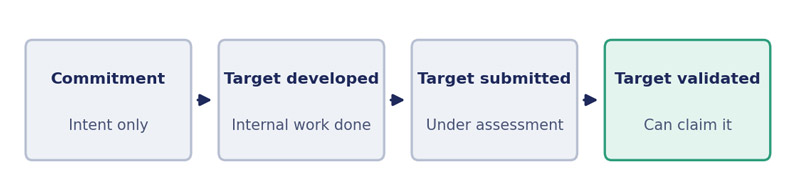
Four statuses that are often used interchangeably
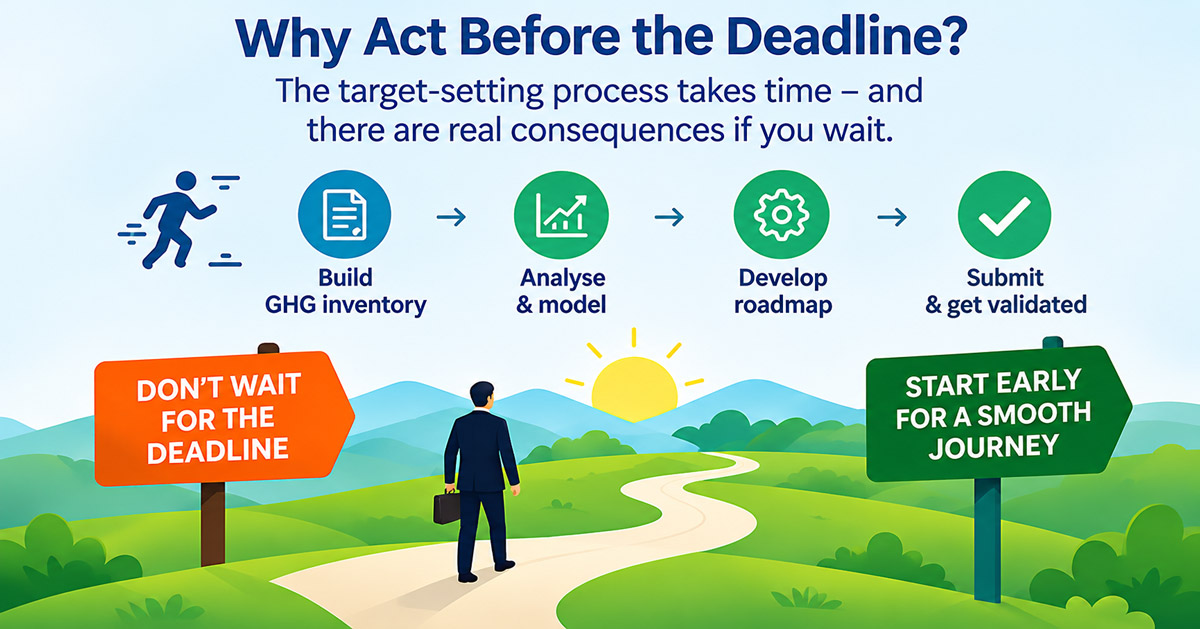
This matters because investors, customers, lenders and supply-chain partners now read the difference closely. A customer questionnaire that asks whether your target is SBTi-validated cannot be answered honestly with “we have committed”. SBTi currently expects companies with a commitment to submit targets within 24 months. Miss it and the dashboard can show “Commitment Removed”. That status is not permanent, and a company can re-engage and still get validated, but it is a public and avoidable credibility problem.
Why documentation is the hardest part?
Validation is an assessment, not a calculation. SBTi is checking whether the proposed target conforms to the applicable criteria and methodology, so everything behind the number has to be explainable, consistent and traceable. This is where most companies discover the real workload. The challenges below come up again and again.
- What is inside the boundary ( organisation Boundary)?
Groups with subsidiaries, joint ventures, leased facilities, acquisitions and divestments often have several informal answers to a simple question: which entities and activities does this target cover? A target cannot be credible while that answer is unclear.
- The GHG inventory was built for reporting
A GHG inventory prepared for an annual report can be perfectly adequate for disclosure and still too thin to support a reduction pathway. Gaps in Scope 1, Scope 2 method and Scope 3 completeness surface only when someone tries to model forward.
- Scope 3 is everywhere and nowhere
For many large organisations the biggest emissions sit with suppliers, customers and products, where data is slow, partial or estimated. The task is not to measure everything equally but to identify which categories are material and build a prioritised roadmap around them.
- Assumptions live in people’s heads
Why a base year was chosen, how renewable electricity is counted, why something was excluded, how an acquisition was treated.These decisions are often made quickly and never written down. A reviewer, or a new team member, cannot reconstruct them.
- The target and the inventory tell different stories
A technically ambitious target on weak data can be harder to validate than a well-designed target on a robust inventory. Reduction rate, coverage, target year and the underlying numbers all have to agree with each other.
- Approval arrives late
The target eventually needs internal management sign-off, and managers reasonably want to know what it commits the business to. If that conversation starts at the end, it can reopen decisions made months earlier.
The journey from target setting to validation
Taken one step at a time, the process is manageable. A practical implementation model has six phases, and each one produces something that must be written down. The durations below are indicative and assume the company has clean data and available decisionmakers, which is rarely the case at the start.
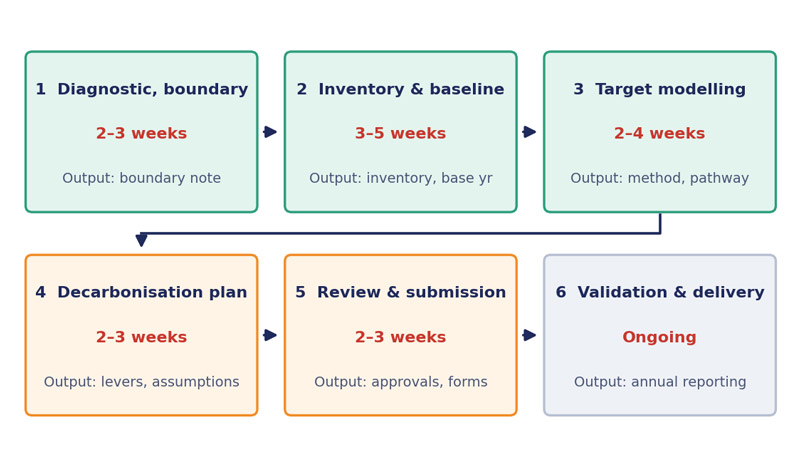
Six phases from diagnostic to validation, and what each one produces
The first three phases are about facts: confirming the boundary, validating the inventory and selecting the method. Many teams underestimate this stage, and it is where specialist support pays for itself, because choosing the wrong methodology can mean significant rework later. The fourth phase turns the target into operations: renewable energy, efficiency, electrification, fuel switching, procurement and supplier engagement. The fifth is the internal technical review and management alignment that should come before submission, not after it.
The sixth phase is the one companies forget. Validation is not the end of the work. Companies are expected to publicly report their inventory and progress against targets every year, and active targets are reviewed periodically against the latest criteria. The company has to move from target setting to target delivery.
One framework Vs Different industries
The principles of target setting are common, but sectorspecific requirements can change how a target is built. SBTi has developed dedicated guidance for activities where a generic approach does not reflect the industry’s pathway. The documentation challenge therefore looks different depending on where the company operates.
| Industry | What shapes the target | Where documentation gets hard |
| Manufacturing and industrial | Energy efficiency, electrification, renewable power, fuel switching, supplier engagement. Scope 3 can dominate. | Showing which emissions the company can realistically influence, and through which decisions. |
| Power and utilities | The generation portfolio: fossil phase-down, renewables, storage, grid change. SBTi is developing a Power Sector Standard. | Treating different energy businesses correctly within the organisational boundary. |
| Automotive and transport | Factory emissions plus vehicles sold and their use: electrification, batteries, supplier decarbonisation. | Linking product-use emissions to the company’s technology plans. |
| Buildings and real estate | Building energy, refrigerants, embodied carbon, leased or financed assets. SBTi Buildings Criteria apply. | Portfolio-level data across owned, leased and developed assets. |
| Land and agriculture (FLAG) | Land-use change, livestock, soil, forestry. FLAG guidance was updated in 2026. | Accounting for land emissions and removals alongside Scope 1, 2 and 3. |
| Financial institutions | Financed or facilitated emissions, handled through portfolio-level methods. | Coverage across asset classes, sectors and exposures. |
| Cement, steel, chemicals, aviation, maritime | Process emissions, fuel and feedstock transitions, sustainable fuels, product-specific intensity. | Defending assumptions about technology availability. |
The implication is simple: before calculating the target, decide which methodology applies to the business. For companies with several business lines, that decision should be made, and recorded, at the boundary stage.
Near-term and net-zero: two questions, one plan
Companies sometimes treat these as alternatives. They answer different questions. The near-term target asks what the company will deliver over roughly the next five to ten years. The net-zero target asks what the long-term pathway looks like, reaching net zero by 2050 at the latest for most companies. Near-term targets are also a requirement for companies pursuing net-zero alignment, so they cannot be skipped.
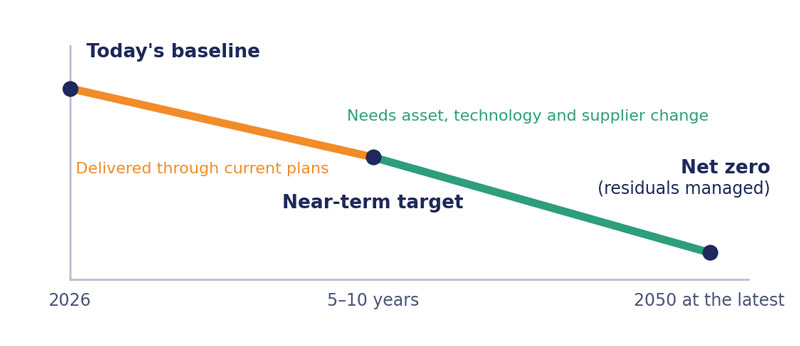
Near-term action leads into the long-term transformation
The net-zero pathway forces harder questions: which assets will need replacing, which technologies will become obsolete, how suppliers will transition, what investment is required and how residual emissions will be handled under SBTi requirements. These are CAPEX, procurement and strategy decisions, which is why the target cannot sit only with the sustainability team.
What happens if the target is not validated?
If a submitted target does not meet the applicable criteria, the company cannot present it as SBTi-validated. The technical issues have to be addressed and the target resubmitted. Beyond the extra work and management time, the consequences are commercial and reputational: delayed responses to customer and investor expectations, disruption to transition planning, and awkward questions where a public commitment has not progressed to validation. This is why the submission date should be the end of a structured internal validation process, not the start of the project.
Why 2026 is a preparation window?
SBTi has published Corporate Net-Zero Standard Version 2.0, with validation against it expected to open from February 2027. Companies setting or updating targets during 2026 can continue to use the current Corporate Net-Zero Standard V1.3.1 and the Corporate Near-Term Criteria. The sensible reading is not to wait and see. It is to use the transition period to fix data, test methodology, align capital planning and engage suppliers, so that governance, strategy, data and methodology problems are not all being solved in the final months before a deadline.