
Chemical plants are among the most demanding industrial environments when it comes to structural safety. Heavy equipment, corrosive chemicals, high temperatures, pressurized systems, storage tanks and continuous operations place significant stress on buildings and supporting structures. A structural weakness that may appear minor during routine operations can become a serious safety risk during an equipment failure, fire, chemical release or extreme weather event.
For chemical manufacturers, structural safety is therefore not simply a construction issue. It is an ongoing risk-management requirement that involves design, inspection, maintenance and periodic structural audits.
In India, several Indian Standards (IS) codes) provide guidance for structural design, loading, materials, concrete structures, steel structures and industrial buildings. Chemical plants must also consider the specific hazards associated with their processes and chemicals.
Why Structural Safety Matters in Chemical Plants
Unlike conventional commercial buildings, chemical plants often contain structures that support heavy and dynamic loads. Pipe racks, equipment platforms, storage facilities, process structures and operating floors may remain exposed to vibration, heat, moisture and corrosive substances for years.
Chemical exposure can accelerate deterioration of concrete and steel. Leakage of corrosive substances can affect foundations, columns, beams and structural connections. Similarly, excessive vibration from rotating equipment can contribute to fatigue and deterioration.
Structural failure can have consequences beyond property damage. A collapsed platform or damaged pipe rack can interrupt critical process lines, release hazardous chemicals and create secondary fire or explosion risks.
This makes structural safety audits particularly important for operating chemical plants.
Key IS Codes Relevant to Chemical Plant Structures
There is no single Indian Standard covering every structural safety requirement of a chemical plant. Compliance generally involves applying multiple standards according to the type of structure and loading conditions along with the terrain condition.
Some of the important standards include:
- IS 456:2000 – Plain and Reinforced Concrete – Code of Practice. It provides requirements for the design and construction of reinforced and plain concrete structures.
- IS 800:2007 – General Construction in Steel – Code of Practice. This is a key reference for structural steel design and construction.
- IS 875 (Part 1 to Part 5) – Design Loads for Buildings and Structures. Its different parts address dead loads, imposed loads, wind loads, snow load andSpecial Loads and Load Combinations
- IS 1893 (Part 1):2016 – Criteria for Earthquake Resistant Design of Structures — Part 1: General Provisions and Buildings. It provides criteria for determining seismic loads and evaluating the earthquake-resistant performance of structures.
- IS 13920:2016 – Ductile Design and Detailing of Reinforced Concrete Structures Subjected to Seismic Forces. It specifies requirements for ductile design and detailing of reinforced concrete structures to improve their performance during earthquakes.
- IS 10262:2019 – Concrete Mix Proportioning – Guidelines – It provides guidelines for proportioning concrete mixes to achieve the required strength, workability and durability.
- IS 1343:2012 – Prestressed Concrete – Code of Practice – It specifies requirements for the design and construction of prestressed concrete structures wherever prestressed construction is adopted
Depending on the facility, additional standards, project specifications, statutory requirements and international standards may also become relevant like BS-EN code and American codes.
The key point for plant operators is that simply referring to an IS code during original construction does not guarantee continued structural integrity. Existing structures need to be assessed periodically based on their current condition, loading and operating environment.
What Should a Structural Safety Audit Examine?
A structural audit of a chemical plant should go beyond a visual inspection of walls and columns. The audit should consider the structural integrity, stability, durability and safety of all buildings, structures, foundations and supporting systems exposed to industrial operations, chemical environments, heavy equipment, vibration, temperature variations and other potential hazards.
- StructuralCondition Assessment through Visual Inspection
Auditors should inspect columns, beams, slabs, foundations, platforms, staircases, walkways and supporting structures for visible deterioration.
Particular attention should be given to:
- Cracks and excessive deflection
- Concrete spalling
- Exposed reinforcement
- Corrosion of reinforcement
- Corrosion of structural steel
- Deformation or buckling
- Damaged welds and bolted connections
- Settlement or movement
- Deterioration of foundations
- Chemical and Environmental Exposure
Chemical plants require special attention to corrosion and chemical attack.
The audit should identify areas exposed to acids, alkalis, solvents, salts, moisture, high temperatures or other aggressive substances. Drainage arrangements should also be reviewed because chemical accumulation or standing water can accelerate structural deterioration.
Protective coatings, corrosion protection systems and concrete surfaces should be examined for damage or failure.
- Equipment and Operational Loads
Structural members may have experienced changes since the plant was originally designed.
The audit should verify whether additional equipment, tanks, pipelines, cable trays or platforms have been installed. Changes in equipment weight or operating loads can affect the original structural design assumptions.Where the existing structural system is found inadequate to safely accommodate the proposed additional loads, suitable retrofitting and strengthening measures shall be recommended and implemented to maintain structural safety, stability, integrity and serviceability.
Dynamic loads and vibration from pumps, compressors and other rotating equipment should also be considered where relevant.
- Pipe Racks and Equipment Platforms
Pipe racks are critical structures in chemical plants because they carry process pipelines, utilities, cable trays and other services.
Inspectors should examine structural members, connections, supports, anchor points and signs of excessive deformation or corrosion.
Equipment platforms and access walkways should be checked for load capacity, stability, corrosion and safe access.
- Fire and Emergency Conditions
Structural safety cannot be separated from major accident scenarios in a chemical plant.
The audit should consider whether important structures could remain stable during foreseeable fire exposure or other emergency scenarios. Areas supporting critical equipment, process lines or emergency systems deserve particular attention.
Structural Safety Audit Checklist
A practical audit checklist for a chemical plant can include:
| Audit Area | Key Checks |
| Structural members | Cracks, deformation, corrosion, damage |
| Concrete structures | Spalling, exposed reinforcement, deterioration |
| Steel structures | Corrosion, buckling, welds and connections |
| Foundations | Settlement, cracking and visible deterioration |
| Pipe racks | Load condition, supports, corrosion and connections |
| Platforms | Stability, loading and physical condition |
| Equipment supports | Foundation condition and equipment loads |
| Chemical exposure | Corrosion and chemical attack |
| Drainage | Water accumulation and chemical drainage |
| Modifications | Additional equipment and structural changes |
| Seismic considerations | Applicable seismic requirements |
| Drawings | Availability of approved structural drawings |
| Maintenance | Previous inspection and repair records |
| Safety actions | Identification and prioritization of deficiencies |
From Inspection to Risk-Based Action
One of the most important outcomes of a structural audit is not merely identifying defects, but understanding their risk significance.
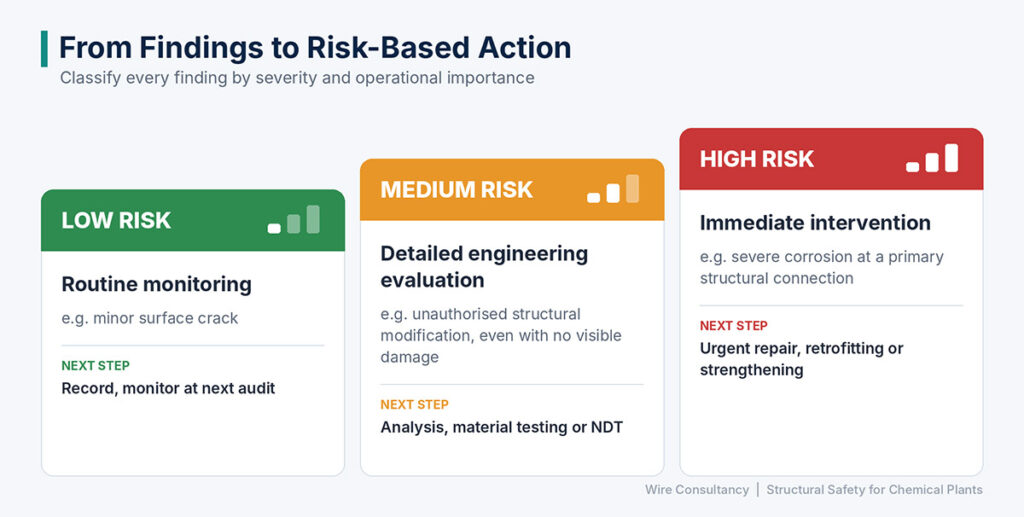
Audit findings should therefore be classified according to severity and operational importance. Where necessary, detailed structural analysis, material testing or non-destructive testing can support the assessment.
Why Periodic Structural Audits Are Essential
Chemical plants continuously evolve. Equipment is replaced, production capacity changes, new pipelines are installed and operating conditions are modified. As a result, the structural condition of a facility can change considerably over its operating life.
Periodic structural audits provide plant owners with an opportunity to identify deterioration before it develops into a major failure. They can also help establish repair priorities, support maintenance planning and improve overall plant safety.
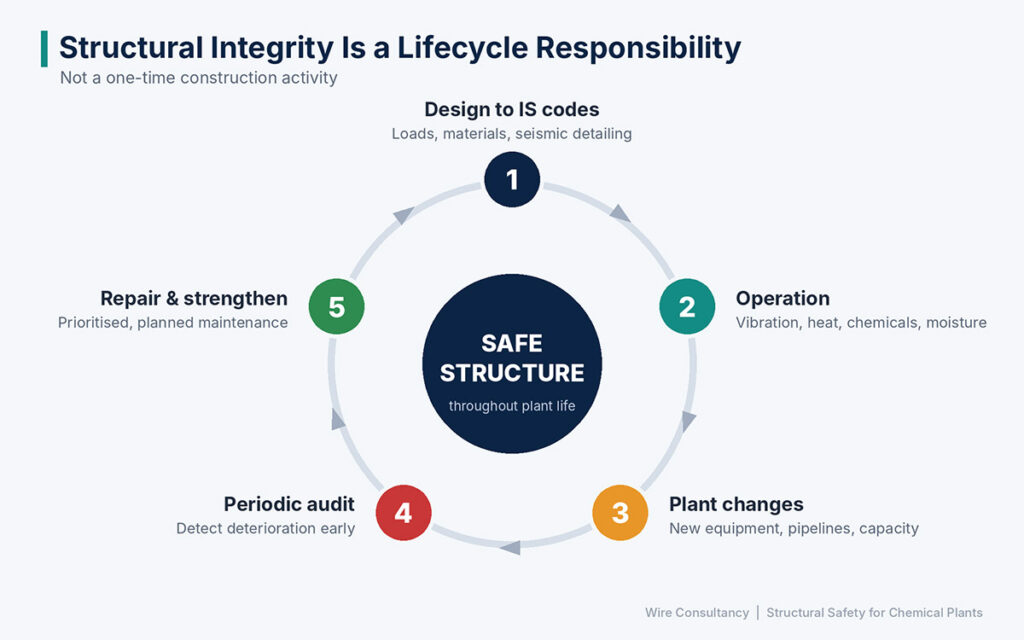
For large chemical facilities, structural integrity should be treated as a lifecycle responsibility rather than a one-time construction activity.
How Wire Consultancy Can Help
Wire Consultancy provides engineering, risk management, EHS and sustainability consulting services for industrial and large-scale facilities. Its structural safety assessment approach can help chemical plants identify structural deficiencies, assess potential risks and develop practical recommendations for corrective action.
A structured assessment can cover critical plant structures, equipment-supporting systems, corrosion-related deterioration, structural modifications and other factors affecting the integrity of industrial facilities.
For chemical plant operators, investing in a systematic structural audit is ultimately an investment in operational continuity, employee safety, asset protection and long-term risk reduction. In an industry where a structural failure can trigger much larger process-safety consequences, maintaining structural integrity should remain a core part of the plant’s overall safety management strategy.