Not long ago, water was just another line on the utility bill. That’s changed. For a growing number of businesses, it’s turned into a supply-chain risk, a regulatory headache, and, for the companies that move early, a real competitive edge.
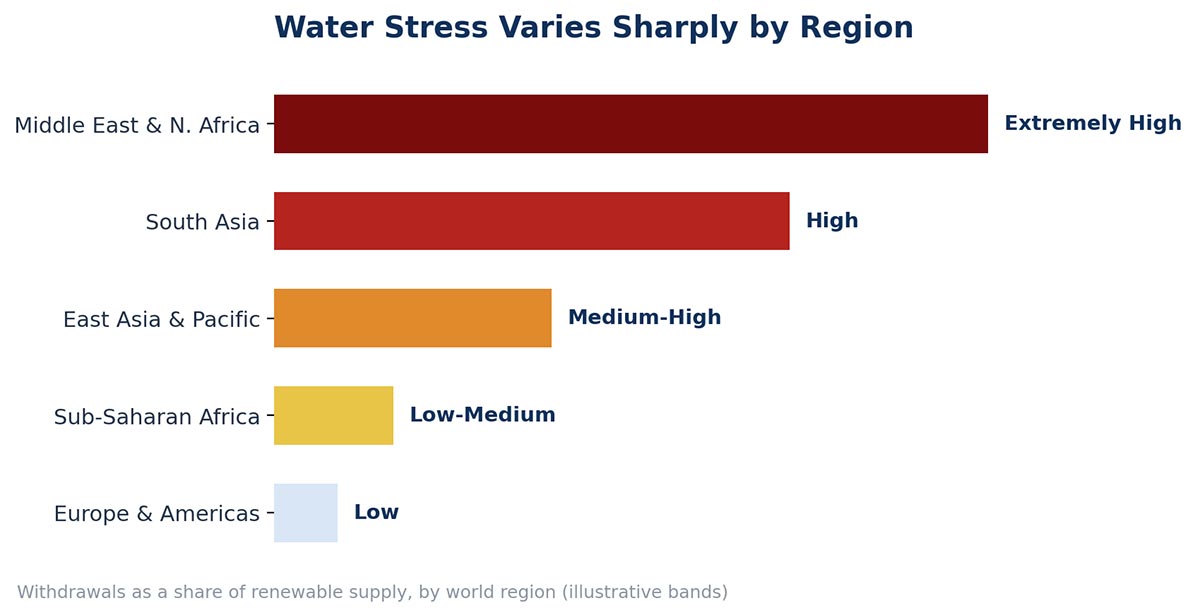
Two out of three people on the planet already face severe water scarcity for at least a month every year, and half the world’s hundred biggest cities are drawing more water than their local supply can replace. If your company runs manufacturing, processing, or cooling operations, that’s not background noise. It’s an operating condition you now have to plan around, not just a line in a sustainability report.
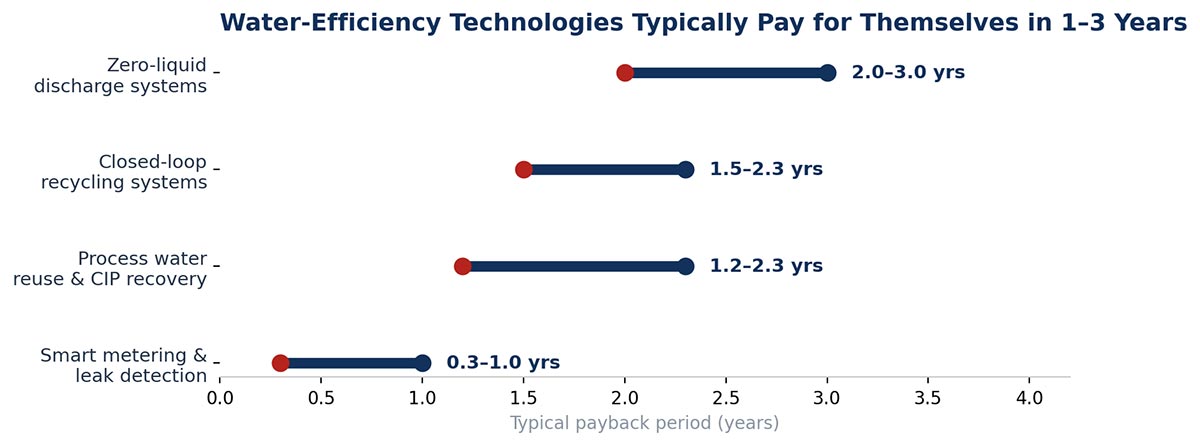
The good news is that the fix isn’t experimental. Cutting consumption through proven technology usually pays for itself within a year or two, and it takes a real risk off the table for good.
| 4Billion+
people face severe water scarcity for part of the year |
50%
of the world’s largest cities face high water stress |
<2.5 yrs
typical payback on water-efficiency investment |
Water Risk Doesn’t Stay in One Place
Ask most executives what “water risk” means and you’ll get one answer “the taps run dry”. That’s part of it, but only part. Water risk shows up in several places at once, which is exactly why it deserves the same disciplined attention companies already give to energy, cyber, or workplace safety.
| PHYSICAL
Drought, falling groundwater tables, and municipal rationing can stop production outright. If a plant relies entirely on outside supply, there’s no cushion when the local basin runs short. |
REGULATORY
Discharge limits, extraction permits, and effluent charges keep getting stricter across most jurisdictions. Even companies that haven’t changed how they operate are finding themselves closer to non-compliance than before. |
| FINANCIAL
Lenders and insurers are getting better at pricing climate and resource risk. That means water exposure can strand assets, push up insurance premiums, and raise the cost of capital. |
REPUTATIONAL
Investors, customers, and local communities are paying closer attention to water stewardship, especially in regions already under stress. It’s becoming part of how a brand gets judged. |
| SUPPLY CHAIN
A company can do everything right internally and still be exposed if its suppliers sit in water-stressed basins. Raw material costs and availability can shift with very little warning. |
OPERATIONAL CONTINUITY
An unplanned shutdown over water doesn’t stay contained. It turns into missed deliveries, contractual penalties, and lost production time that’s hard to make up later. |
This isn’t theoretical. Corporate disclosures already show it that analysis across major water-intensive sectors has found tens of billions of dollars in assets at risk or stranded because of water scarcity, pollution, and regulatory change. Drought-driven agricultural losses alone add up to tens of billions of dollars a year worldwide.
“Water is no longer just an environmental compliance metric — it is a strategic risk to manage and a genuine financial opportunity to capture.”
Cape Town’s drought between 2015 and 2018 gets brought up a lot, and for good reason. It shows how quickly water risk can go from background noise to a full-blown emergency.
| MUNICIPAL / REGIONAL WATER CRISIS
Cape Town’s “Day Zero” Drought (2015–2018) |
||
| SITUATION | After three years of drought, the city came within weeks of shutting off municipal water to about 3.7 million people, with dam storage down to roughly 20–21% of capacity. | |
| RESPONSE | The city rationed water to 50 litres per person per day, ran hard public awareness campaigns, and pushed demand management wherever it could. That, combined with better rainfall, just barely averted total system failure. | |
| IMPACT | Before the crisis eased, agricultural losses topped US$400 million, and somewhere between 25,000 and 30,000 agricultural jobs were affected. | |
| ~20%
dam storage at low point |
$400M+
agricultural losses |
50%
water-use cut under duress |
The real lesson here isn’t about Cape Town specifically. It’s about timing. The city did manage the cuts it needed, but only under emergency conditions, at real social and economic cost, and well past the point where planning could have made things easier. Companies that wait for their own “Day Zero” tend to end up in the same spot: forced into expensive, disruptive change instead of a planned upgrade they could have funded and scheduled on their own terms.
Cutting Consumption Is the Real Lever
The biggest lever for water resilience has nothing to do with finding new sources of water. It’s about needing less of it to begin with. A small set of mature, well-proven technologies account for most of the reduction companies see in industrial water use, and they tend to pay for themselves fast.
| Closed-Loop Recycling
Instead of discharging process water after a single use, it’s treated and put back into the system on-site. In water-intensive processes this alone can cut freshwater intake by 80–90%. |
Smart Metering & IoT Monitoring
Flow and leak sensors flag losses as they happen rather than months later on a water bill. It’s usually the fastest and cheapest win on the list, often paying back in under a year. |
| Membrane & Reverse-Osmosis Treatment
Wastewater gets purified to reuse-grade quality for boilers, cooling towers, and cleaning, so recycled supply replaces freshwater purchases instead of going to waste. |
Zero-Liquid Discharge
Nearly all process water gets recovered and reused, which removes discharge risk altogether. It’s a heavier investment, best suited to sites in the most water-stressed locations. |
What This Looks Like in Practice
None of this is theoretical. These systems are already producing measurable results across water-intensive industries. The examples below give a sense of what companies are seeing once they apply this at facility scale.
| TEXTILES & GARMENTS
Cutting Dye-House Water Use by 80%+ |
||
| CHALLENGE | Wet-processing and dyeing are some of the thirstiest steps in textile manufacturing — typically around 150 litres of water for every kilogram of fabric produced. | |
| RESPONSE | A closed-loop system was installed to treat and recirculate process water instead of sending it straight to discharge after one pass. | |
| 150→25 L/kg
water use per kg fabric |
~$240K
annual savings |
~2 yrs
payback period |
| FOOD & BEVERAGE
Recovering Process Water at a Bottling Plant |
||
| CHALLENGE | At a mid-scale bottling and food-processing facility, clean-in-place (CIP) cycles and condensate loss were driving freshwater consumption up relative to output. | |
| RESPONSE | Automated CIP recovery and condensate reuse brought consumption down from around 3.5 litres to 1.4 litres for every litre of finished product. | |
| 180M L/yr
freshwater saved |
~$380K
annual savings |
~2 yrs
payback period |
| PHARMACEUTICALS & CHEMICALS
Turning a Liability into Reusable Supply |
||
| CHALLENGE | Hazardous rinse streams had to be trucked offsite for disposal — an ongoing cost and a standing regulatory headache. | |
| RESPONSE | Onsite treatment turned that rinse water into ultra-pure feed for cooling towers and boilers, which took offsite waste transport out of the picture almost entirely. | |
| ~$520K
annual savings |
~2.3 yrs
payback period |
Near-zero
offsite disposal cost |
| POWER & METALLURGY
Protecting Uptime at a 500 MW Facility |
||
| CHALLENGE | Cooling-tower blowdown was pushing up auxiliary water use and leaving the plant exposed to municipal supply cuts whenever things got dry. | |
| RESPONSE | High-cycle recirculation and blowdown recovery brought down both water intake and the energy cost of pumping it. | |
| 2.5M m³/yr
water recovered |
~$850K
annual OPEX savings |
~1.5 yrs
payback period |
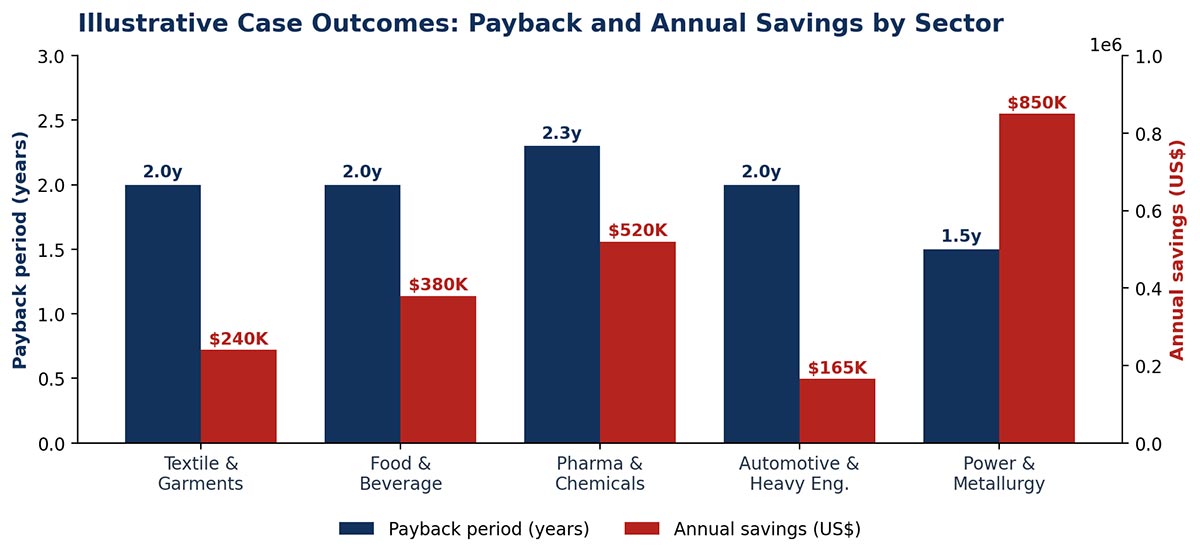
Figures above are illustrative, drawn from public industry case data (IFC Cleaner Production Toolkit, World Bank Eco-Industrial Park studies, and national water-efficiency award programs); actual results will vary by facility, geography, and technology choice.
The Long-Term Payoff
The case for acting early isn’t purely defensive, either. Companies that build water efficiency in ahead of time end up with advantages that a last-minute compliance scramble simply can’t match:
| OPERATIONAL CONTINUITY
Less reliance on municipal supply means production keeps going through droughts and rationing orders — the kind of disruption that stalls competitors who didn’t prepare. |
LOWER, MORE PREDICTABLE COSTS
Once the investment pays for itself, recycled water becomes a cost you control, not one that rises every time tariffs and effluent charges go up. |
| REGULATORY READINESS
Discharge and extraction rules are heading in one direction: stricter. Moving ahead of the mandate means adapting on your own schedule instead of scrambling under enforcement pressure. |
ACCESS TO CAPITAL
Solid water performance is starting to show up in ESG ratings, which in turn makes green financing and sustainability-linked loans easier to access. |
None of this asks a company to solve global water scarcity. It just asks leadership to treat water the way it already treats energy or safety: as something to actively manage, not a bill that gets paid and forgotten.
Getting Started
- Assess — get a clear picture of current water use and flag where the biggest cost and risk exposures sit.
- Prioritize by ROI — model out the returns on metering, reuse, and recycling before committing capital.
- Start with quick wins — smart metering and leak detection are cheap and pay back fast.
- Scale up — bring in closed-loop recycling and reuse systems once the case has proven itself.
“Cutting water use through the right technology may be one of the fastest-paying, lowest-risk moves a business can make right now.”
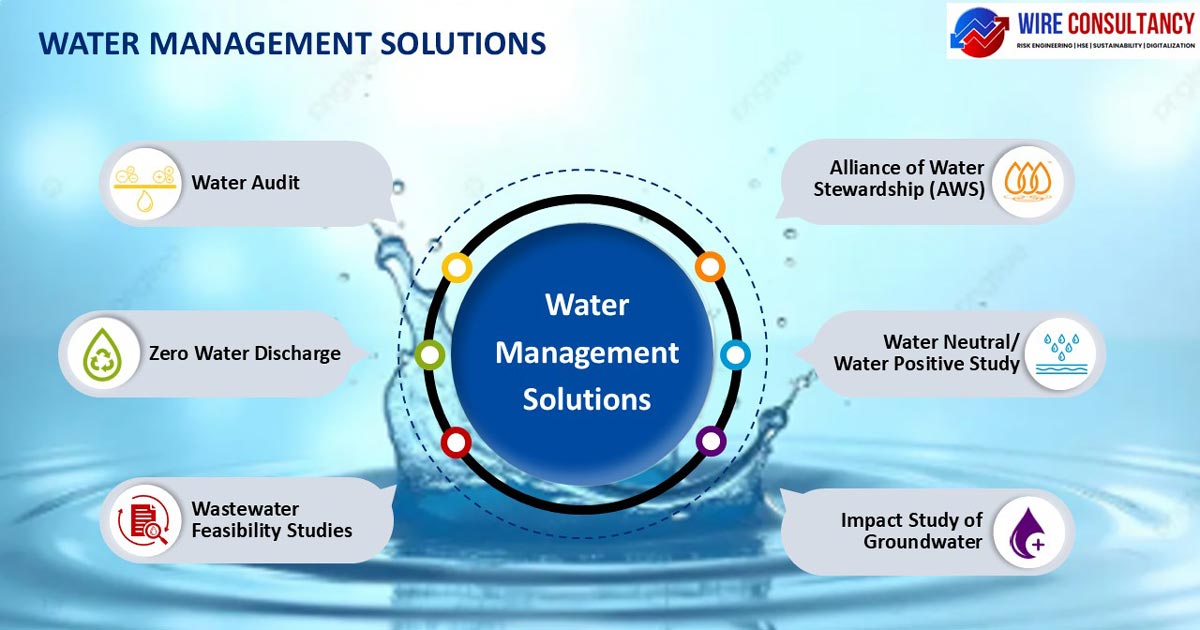
Wire Consultancy works with industrial and commercial clients to assess water risk and put the right mix of efficiency technology in place.Water audits, zero-liquid-discharge design, wastewater feasibility studies, water stewardship certification, and groundwater impact assessments are among them.