
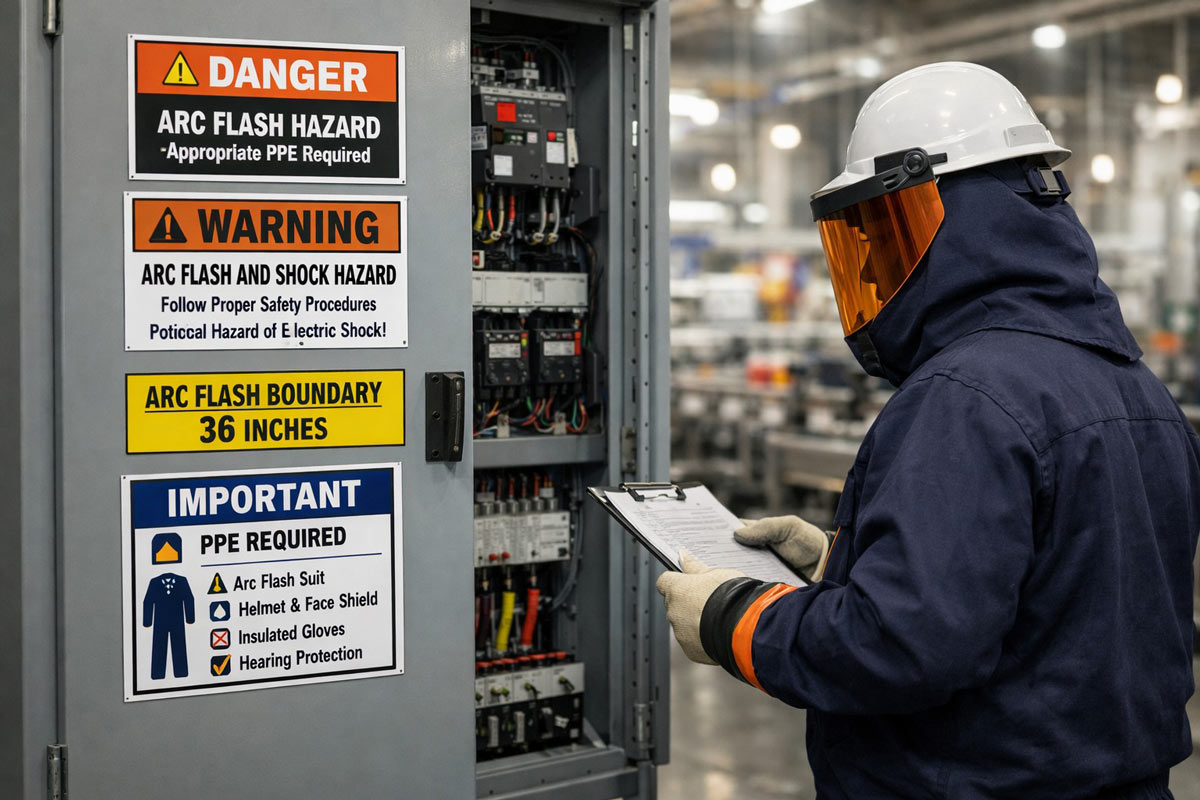
On a busy factory floor, electrical panels are opened every day—sometimes for routine maintenance, sometimes to troubleshoot an unexpected shutdown. For many technicians, the danger seems manageable as long as they avoid touching live conductors. What remains largely invisible is the most violent electrical hazard of all: arc flash. In Indian manufacturing plants, this hidden risk has injured workers, destroyed equipment, and disrupted production in a matter of seconds.
Understanding the Reality of an Arc Flash Incident
An arc flash occurs when an electrical fault causes current to travel through the air between conductors or from a conductor to ground. This creates an explosive release of energy called incident ebergy, producing intense heat, blinding light, pressure waves, and molten metal. Unlike electric shock, an arc flash does not require direct contact. A worker standing several feet away can suffer severe burns or fatal injuries.
Temperatures during an arc flash can exceed 19,000 degrees Celsius, instantly vaporizing copper and expanding it into plasma. The resulting pressure wave can knock personnel off their feet, while flying debris causes secondary injuries. In manufacturing plants, where panels are often located near production areas, the risk extends beyond the electrical team.
Why Indian Manufacturing Plants Face Higher Arc Flash Risk
Many Indian factories operate with electrical systems that have evolved over decades. Load expansions, machinery upgrades, and temporary modifications are often carried out without revisiting the original electrical design. As a result, fault levels increase while protection systems remain unchanged.
Common conditions that elevate arc flash risk in Indian plants include:
- Large transformers supplying low-voltage systems
- Aging switchgear with longer clearing times
- Incomplete or outdated single-line diagrams
- Maintenance work carried out under energized conditions
In such environments, traditional safety practices—such as insulation checks or earthing continuity—do not address the severity of arc flash hazards.
What an Arc Flash Study Actually Evaluates
An arc flash hazard analysis as per IEEE 1584-2018 employs empirical equations and system-specific parameters—such as transformer impedance, cable lengths/impedances, protective device time-current characteristics (TCCs), and relay settings—to compute prospective incident energy (Ei) in cal/cm² and arc flash boundary (AFB) distances for bolted fault scenarios across electrical equipment.
The analysis models fault clearing times via short-circuit studies (IEC 60909) integrated with protective device coordination, quantifying released energy calculated from IEEE 1584. The incident energy is directly proportional to the fault clearing time and a marginal reduction in clearing time (e.g., via faster relays or fuses) exponentially mitigate burn severity per Table 130.7(C)(15)(a) in NFPA 70E-2024.
Compliant with NFPA 70E Article 130, outputs include:
- Incident energy (Ei) contours at equipment openings (e.g., switchgear, MCCs)
- AFBs for 1.2 cal/cm² on set to second-degree burn threshold
- PPE category/risk assessments per NFPA 70E Annex K
- Mitigation strategies: engineering (e.g., current-limiting reactors, ARCs) or administrative (e.g., enhanced LOTO)
This transforms probabilistic fault energies into actionable hazard/risk categories (0-4), enabling informed PPE selection and safe work practices.
From Calculation to Prevention on the Factory Floor
The engineering merit of an arc flash study transcends IEEE 1584 computations, manifesting in applied risk controls: NFPA 70E-compliant labels on equipment specify hazrd/risk levels, incident energy (Ei), AFBs, and shock PPE requirements, enabling maintenance personnel to select arc-rated PPE (e.g., CAT 2 for 8 cal/cm²) or enforce de-energization per Article 110.2.
Critically, analyses reveal low/no-cost optimizations to curtail Ei:
- Relay setpoint refinements (e.g., reducing Zone 1/2 timers) or TCC tweaks for 20-50% clearing time reductions
- Enhanced coordination margins, minimizing mis operations via ETAP or other software modelling
- Procedural upgrades: remote racking, maintenance protocols, or voltage-rated gloves
These interventions proactively compress Ei envelopes—often below 1.2 cal/cm² thresholds—elevating safety from post-incident NFPA/OSHA compliance to predictive hazard engineering.
The Human Cost of Ignoring Arc Flash Hazards
Arc flash injuries are often life-altering. Survivors may suffer permanent burns, vision damage, or hearing loss. For employers, the impact extends beyond medical costs. Investigations, downtime, legal exposure, and reputational damage can follow a single incident.
In a country where skilled industrial electricians are in short supply, protecting experienced workers is not just a safety obligation—it is a business necessity.
Why Arc Flash Studies Are Still Underutilized in India
Despite mandates under Factories Act 1948 (as amended), CEA Regulations 2023, and alignment with NFPA 70E, arc flash studies remain under-deployed in Indian manufacturing and other industries. Key impediments include:
- Misconception of low fault probability, ignoring IEEE 1584-modeled arcing faults (90% of incidents per NFPA 70E data)
- Overreliance on generic PPE (e.g., Class E gloves, FR cotton), presuming adequacy absent
quantification
PPE constitutes the final barrier (NFPA 70E Table 130.7(C)(15)(b)); uncalibrated selection risks mismatches. Studies deliver precise Ei (cal/cm²), AFBs, and coordination audits—transforming empirical PPE choices into evidence-based protocols, averting incidents like those in recent CEA-reported switchyard events.
How Wire Consultancy Helps
Wire Consultancy delivers IEEE 1584/NFPA 70E-compliant arc flash hazard analyses for Indian manufacturing and industries, leveraging site-specific data—transformer vectors, relay TCCs, and ETAP short-circuit models—to compute incident energy (Ei), AFBs, and Hazard/Risk levels under live operating envelopes.
Our methodology integrates:
- Fault simulations accounting for Indian grid dynamics (CEA compliant)
- No-downtime optimizations: relay retuning, protection setting tweaks for 30-60% incident energy reductions
- Output deliverables: labeled panels, SOPs, and audit-ready reports per IEEE 1584 & NFPA 70E
This converts analytical outputs into executable safety protocols, ensuring worker protection, regulatory adherence (Factories Act/CEA), and uninterrupted shop-floor reliability.