Email Address

info@wireconsultants.com

Call Now

+91-9810827158

Electrical Design & Consulting

Earthing Audit & Grounding System Health Assessment

Wire Consultancy delivers comprehensive Earthing System Audits for power substations, EHV/LV networks, and industrial plants across India. We identify hidden grounding failures — below ground — before they cause equipment damage, nuisance tripping, or fatal electric shock.
Projects Completed
0 +
Countries Served
0 +
Live System Testing
0 %

IS / IEEE

Standard Compliant

What We Assess

Compliant Standards

What Is It

What is an Earthing Audit?

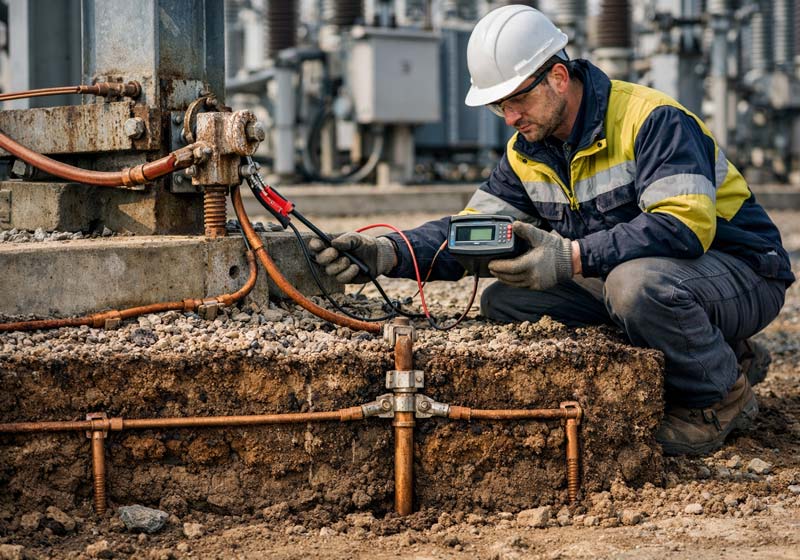
An Earthing Audit (also called a Grounding System Health Assessment) is a systematic, field-based evaluation of an electrical system’s complete earthing infrastructure — from the equipment earth conductor strip, through risers, down to the buried earth grid or mat and earth electrodes.

Most facilities only measure pit electrode resistance periodically — but this alone is insufficient. As per CEA Regulation 41(xv)(b), the entire fault current loop — equipment body → earth conductor strip → electrode → return path — must offer a low impedance so that circuit breakers trip on time during a fault. A healthy individual electrode reading can mask a broken or corroded riser that would prevent the breaker from operating correctly.

Out-of-Sight, Out-of-Mind Problem

Buried conductors, grids, and risers are invisible to routine inspections and corrode silently over years, creating hidden safety hazards.

Conventional Testing Falls Short

Simple electrode resistance measurement ignores the continuity and integrity of the earth conductor strip, grid, and all parallel paths — a multi-path grid can show low resistance even when risers are completely open.

Live System — No Shutdown Required

Wire Consultancy’s methodology uses non-intrusive, specialised instruments to perform the complete audit on energised, live systems without plant shutdown.
Why It Matters

Why is an Earthing Audit Necessary?

Earthing systems deteriorate silently. Corrosion, thermal stress, soil chemistry, and poor workmanship degrade the system over time — creating risks that are invisible until a fault or fatality occurs.

Environmental Corrosion

Soil chemistry, moisture, and galvanic reactions corrode buried copper/GI conductors and electrode rods, increasing resistance and breaking continuity — often without any visible signs above ground.

Thermal & Electrical Stress

Repeated fault currents and overload cycles apply thermal stress on conductor joints and terminations, loosening them over time and introducing dangerous resistance in the earth loop path.

Poor Workmanship & Ageing

Improper crimp joints, unsupported conductor bends, or shallow electrode installations degrade far faster than correctly installed systems — and may never have met design intent from day one.

System Modifications

Plant expansions, equipment upgrades, or load increases can invalidate the original earthing design. Breaker protection settings calculated for the original fault current path become unsafe after modifications.

Grid Islanding

In large substation earth grids, individual grid sections can become electrically isolated (islanded) due to open conductors — leaving equipment in that zone with no fault current return path at all.

Regulatory Compliance

CEA Regulations, IS 3043:2018, and factory/insurance inspectorate requirements mandate periodic verification of earthing system adequacy. Non-compliance carries legal liability and insurance invalidation risk.

Scope of Work

Earthing Audit Scope

Our audit scope is structured by voltage class. Select the appropriate category for your facility to view the full scope of tests and assessments performed.

01

Soil Resistivity Test (Wenner 4-Pin)

Multi-depth soil resistivity profiling as per IEEE 81 to characterise soil layers for earth grid modelling and future design validation.

02

Earth Electrode Resistance Test

Fall-of-potential (3-point) and selective clamp-on methods to measure individual electrode resistance and total system resistance.

03

Riser Integrity Test

Identifies open, weak, or corroded above-ground and buried riser conductors connecting equipment to the earth grid — the most commonly missed failure point.

04

Earth Grid Integrity Test

Detects grid islanding (intra-grid disconnection) and inter-grid isolation using specialised current injection and signal measurement techniques.

05

Touch & Step Potential Measurement

Field measurement of actual touch and step potentials at critical locations and comparison against IEEE 80 safety thresholds for the applicable soil resistivity and fault duration.

06

Earth Grid Modelling & Simulation

Software-based modelling of the existing earth grid to simulate fault scenarios, validate adequacy against design intent, and identify areas requiring augmentation.

07

Corrosion Assessment

Visual and electrochemical evaluation of buried conductor condition, joint quality, and exposure risk using soil pH, moisture, and resistivity data.

08

Documentation & Design Review

Review of existing earthing drawings, test records, soil reports, and protection relay settings against current standards and measured field data.

01

Soil Resistivity Test

Surface soil resistivity measurement to assess electrode installation adequacy and predict corrosion risk.

02

Earth Electrode Resistance Test

Individual electrode pit resistance measurement to verify compliance with IS 3043 limits (≤1Ω for power systems, ≤5Ω for general installations).

03

Earth Loop Impedance Test

Measurement of the complete fault loop impedance (phase → line → load → earth → back to source) to verify that circuit breakers will operate within safe disconnection times.

04

Prospective Fault Current Test

Field verification of prospective earth fault current magnitude to confirm breaker interrupting capacity and disconnection time compliance.

05

Riser & Earth Conductor Integrity

Continuity and integrity testing of all equipment-to-electrode conductor strips, cable trays, and bonding conductors throughout the facility.

06

Corrosion & Visual Assessment

Visual inspection of accessible earthing conductors, electrode pits, and earth bars for corrosion, mechanical damage, loose connections, and non-compliant materials.

01

DC Array Earthing Assessment

Evaluation of PV module frame bonding, string combiner box earthing, and DC cable armour bonding across the entire array field.

02

Inverter Station Grounding Audit

Soil resistivity, electrode resistance, and grid integrity tests at each inverter/transformer skid location.

03

Main Grid & Switchyard Earthing

Full EHV-class earthing audit for the pooling substation / grid connection point, including touch/step potential assessment.

04

Lightning Protection Bonding Check

Verification of down conductor bonding to the earth grid and check for equipotential bonding between LPS earth terminations and electrical earthing system.

05

Stray Current & Corrosion Survey

Survey for DC stray currents from adjacent rail/cathodic protection systems that can aggressively corrode buried earthing conductors.

06

CEA / CEIG Compliance Review

Documentation review to support CEA/CEIG commissioning approvals and grid connectivity conditions for earthing system adequacy.

Our Process

Earthing Audit Methodology

A structured, standards-based five-phase approach ensuring no component of the earthing system is overlooked — conducted entirely on live, energised systems.

Pre-Audit Review

Collection and review of SLDs, earthing drawings, test history, CEA/protection relay records, and previous audit reports.

Site Survey & Inspection

Physical walkdown of all earthing electrodes, conductor strips, risers, joints, earth bars, and bonding connections across the facility.

Field Testing

Systematic execution of all applicable tests (soil resistivity, electrode resistance, riser/grid integrity, loop impedance, touch/step potentials) using calibrated instruments on live systems.

Analysis & Modelling

Data analysis against IS/IEEE thresholds, earth grid simulation for EHV systems, and identification of non-compliances and risk-ranked deficiencies.

Report & Recommendations

Comprehensive audit report with photographic evidence, test data, deficiency findings, and prioritised remedial recommendations with compliance roadmap.

What You Receive

Audit Deliverables

Every Wire Consultancy Earthing Audit delivers a complete, actionable package — not just a test certificate.

Comprehensive Audit Report

Full test data, site photographs, deficiency observations, root cause analysis, and compliance status against applicable standards.

Defect Location Map

Marked-up facility layout identifying exact locations of open risers, corroded conductors, and grid islanding — enabling precise, cost-effective remediation.

Touch & Step Potential Report

Measured vs. IEEE 80 permissible potential comparison with identified unsafe zones and mitigation options (crushed stone, insulating mats, grid augmentation).

Prioritised Recommendations

Risk-ranked corrective action plan with specific technical recommendations, material specifications, and timeline guidance for remediation activities.
Impact Analysis

Consequences of a Deficient Earthing System

A failing grounding system is the root cause of a wide range of operational and safety failures that are frequently misdiagnosed or attributed to other equipment problems. Earthing systems deteriorate silently. Corrosion, thermal stress, soil chemistry, and poor workmanship degrade the system over time — creating risks that are invisible until a fault or fatality occurs.

Comprehensive Audit Report

What Our Audit Identifies & Resolves

Industries Served

Who Needs an Earthing Audit?

Any facility with a buried earthing system older than 3 years, that has undergone modification, or where a safety incident has occurred should commission an Earthing Audit.

Power Substations

EHV/HV/MV AIS & GIS substations — transmission, distribution, and pooling stations.

Power Generation Plants

Thermal, hydro, and gas-based power stations where reliable earth grid integrity is safety-critical.

Solar & Wind Farms

Utility-scale renewable plants with extensive DC array earthing, inverter earthing, and grid connection substations.

Oil, Gas & Petrochemical

Hazardous area facilities requiring flawless earthing and bonding for static charge and explosion prevention.

Manufacturing & Process Plants

Continuous process industries where nuisance tripping from earthing failures causes costly production disruptions.

Data Centres

Mission-critical facilities where ground reference quality directly affects sensitive IT equipment reliability.

Metro Rail & Transport

Traction power systems with stray DC current risks requiring comprehensive earthing and bonding assessment.

Commercial & Institutional

Hospitals, IT parks, airports, and large commercial complexes requiring statutory electrical safety compliance.

Industries Served

Who Needs an Earthing Audit?

Any facility with a buried earthing system older than 3 years, that has undergone modification, or where a safety incident has occurred should commission an Earthing Audit.

Enhanced Personnel Safety

Eliminates unsafe touch and step potentials that can cause fatal shock — particularly during earth fault conditions in substations and switchyards.

Reliable Protection System Operation

Ensures breakers trip within safe times during faults, preventing fire, short-circuit escalation, and equipment damage across the electrical system.

Reduction in Equipment Failures

Studies indicate a 38–40% reduction in electronic equipment and relay failures after grounding system deficiencies are corrected.

Regulatory & Insurance Compliance

Demonstrates due diligence under CEA Regulations, IS 3043, and factory/inspectorate requirements — essential for licence renewals and insurance validity.

Cost-Effective, Targeted Remediation

Pinpoint defect location maps allow precise excavation and repair at specific points — eliminating the need for expensive blanket re-earthing of entire grid sections.

Impact at a Glance

Reduction in equipment failures post-audit
40%
Earth faults are phase-to-ground (most common)
85%
Fire incidents linked to electrical/earthing faults
55%
Facilities with hidden earthing deficiencies (audits)
70%

CEA Regulation Reference

As per CEA Regulation 41(xv)(b), the earthing system resistance shall be maintained as low as possible so that a sufficiently large fault current flows and the circuit breaker trips on time to isolate the faulty circuit.
Why Wire Consultancy

The Wire Consultancy Advantage

We are not just auditors — we are power systems engineers with deep domain knowledge of protection systems, substation design, and CEA compliance. This means our findings are always contextualised within your system’s operational reality.

Qualified Expert Team

Chartered Engineers (IEI), NEBOSH-certified professionals, Class A Licensed Electrical Supervisors — with experience on India's largest substations and power plants.

Live System Testing — No Shutdown

Specialised non-intrusive instrumentation enables complete earthing audits on energised systems, eliminating production disruption and shutdown costs.

National & International Standards

All recommendations reference IS 3043, IEEE 80, BS 7430, CEA Regulations, and CBIP Manual 339 — ensuring both domestic compliance and international best practice.

Pinpoint Defect Location

We don't just tell you something is wrong — we tell you exactly where. Precise GPS/plan-referenced defect marking minimises the cost of remediation.

Expert Credentials & Standards

Sectors Covered

Trusted By

FAQs

Frequently Asked Questions

Frequently Asked Questions
A simple resistance test only measures the electrode pit resistance — it tells you nothing about the condition of the conductor strip connecting equipment to the electrode, the integrity of the buried earth grid, or whether the complete fault current loop has adequate continuity. An Earthing Audit evaluates all components of the earthing system as a complete circuit, including riser integrity, grid continuity, loop impedance, and touch/step potentials — the full picture required to ensure breakers trip on time during a fault.
Yes — this is one of Wire Consultancy’s key differentiators. We use specialised non-intrusive test instruments and methodologies that allow the complete Earthing Audit to be performed on live, energised systems. Our engineers follow strict PPE protocols and safe work procedures throughout, ensuring zero disruption to your operations.
The riser is the above-ground or shallow-buried conductor strip that connects each piece of electrical equipment to the buried earth grid. If a riser is open (broken) or has a high-resistance joint, even a perfectly healthy earth grid will fail to provide a fault current path for that specific equipment — the breaker will not trip on time. Riser integrity testing is critical precisely because a multi-path grid can still show a low overall resistance reading even when individual risers are completely disconnected.
CEA Regulations 2021 (Regulation 41) require that earthing systems be maintained in effective condition at all times and tested periodically. State Electricity Inspectorates, insurance companies, and factory act compliance authorities often require evidence of earthing system adequacy. While the periodicity may not always be explicitly mandated, failure to maintain an adequate earthing system carries criminal liability under the Indian Electricity Act 2003 in the event of an accident. Regular audits are strongly recommended and often required for insurance validity.
IS 3043:2018 and CEA Regulations recommend periodic inspection and testing of earthing systems. For power substations and EHV systems, an audit every 2–3 years is standard practice, with annual electrode resistance checks in between. For LV industrial and commercial facilities, audits every 3–5 years are recommended, or after any significant load addition, modification, or electrical incident. Facilities in coastal, high-humidity, or chemically aggressive soil environments may require more frequent assessment.
The primary standards for earthing systems and audits in India are: IS 3043:2018 (Code of Practice for Earthing), CEA Measures Relating to Safety and Electric Supply Regulations 2021, CBIP Manual 339 (for substation earthing), and internationally, IEEE 80-2013 (Guide for Safety in AC Substation Grounding) and IEEE 81-2012 (Measurement of Earth Resistivity and Ground Impedance). Wire Consultancy’s audits reference all applicable standards for your specific facility type.
Grid islanding occurs when a section of the buried earth grid becomes electrically disconnected from the rest of the grid — creating an isolated “island.” During a fault, equipment connected only to the islanded section has no return path for fault current, so the breaker will not trip and the fault persists. This is particularly dangerous in large substations and can lead to sustained arc flash events, equipment destruction, and fire. Wire Consultancy’s grid integrity test specifically detects intra-grid (within one grid) and inter-grid (between multiple grid sections) islanding.
You will receive: (1) A comprehensive audit report with all test data, site photographs, and compliance status; (2) A defect location plan identifying exact positions of open risers, corroded conductors, and islanded grid sections; (3) A touch and step potential assessment report (for EHV systems); (4) A prioritised remedial action plan with specific technical recommendations, material guidance, and timelines; and (5) A compliance summary against IS 3043, IEEE 80, and CEA Regulations.
Field Experience

Insights, Case Studies & Project Experience

Stay updated with practical insights, industry knowledge, and real project case studies from Wire Consultancy. Our articles explain technical challenges, compliance requirements, and engineering solutions used across different industrial sectors.

Is Your Earthing System Truly Safe?

Most earthing failures are invisible until a fault occurs. Don’t wait for a tripping failure, equipment damage, or a safety incident. Commission a Wire Consultancy Earthing Audit today.
Get in Touch

Request Your Earthing Audit

Share your facility details and our earthing specialists will contact you within 24 hours to discuss the audit scope and provide a customised proposal.

Head Office

India (New Delhi) · UAE (Dubai) · USA

Phone

+91-9810827158 / +91-9818257504

Email

info@wireconsultants.com

    Get In Touch

    Trusted by Industry Leaders

    Copyright © 2025 Wire Consultancy | All Rights Reserved

      Get In Touch