
In India’s commercial and industrial ecosystem, structural audits are no longer just regulatory checkboxes—they are critical tools for risk management, operational continuity, and asset lifecycle optimization.
From manufacturing plants and warehouses to office complexes and logistics hubs, structural integrity directly impacts safety, uptime, and compliance. While many decision-makers search for “structural audit cost in India,” the more relevant question is: what drives the cost, and what exactly does a professional audit cover?
For commercial and industrial facilities, the answer lies in understanding the technical scope and influencing factors, rather than focusing on generic price benchmarks.
Why Cost Varies in Commercial & Industrial Structural Audits
Structural audit costs are not standardized as each facility varies in design, load conditions, and operational environment. In commercial and industrial sectors, structural audits are engineering assessments rather than routine inspections. As per NBC Clause 14.4.2, periodic inspections are recommended every 3 to 5 years and should not exceed a 5-year interval.
1. Scale and Structural Complexity
Large commercial buildings and industrial facilities often involve:
- Multi-storey RCC or composite structures
- Long-span steel frameworks
- Heavy-load bearing floors
Such structures require extensive inspection coverage, engineering analysis, and often multiple testing methodologies.
2. Operational Load Conditions
Unlike residential buildings, industrial and commercial facilities operate under dynamic and sometimes extreme loading conditions:
- Heavy machinery and vibration loads
- High-density storage systems
- Continuous operational cycles
Structural audits must evaluate whether the building can safely sustain these loads, both current and future.
3. Ageing Infrastructure and Exposure Conditions
Industrial environments often accelerate structural deterioration due to:
- Chemical exposure
- Moisture and leakage
- Temperature variations
Older structures or those exposed to aggressive environments require deeper investigation and advanced testing.
4. Depth of Technical Assessment
The scope of a structural audit can vary significantly depending on the level of detail required. For commercial and industrial clients, audits typically go beyond basic inspection and include:
- Non-destructive testing (NDT)
- Material strength evaluation
- Structural analysis and load validation
A more comprehensive scope naturally requires more engineering effort and resources.
5. Accessibility and Live Operations
Many industrial audits must be conducted without shutting down operations. This introduces complexities such as:
- Restricted access areas
- Safety coordination with plant teams
- Night or shutdown-based inspections
These factors influence the planning, execution strategy, and overall effort involved.
6. Compliance and Certification Requirements
Commercial and industrial buildings often need structural audits for:
- Regulatory compliance
- Insurance validation
- Safety certifications
Such audits demand detailed documentation, engineering validation, and formal reporting formats.
Scope of Structural Audit for Commercial & Industrial Buildings
A professional structural audit is a multi-layered engineering exercise. It is designed not just to identify visible issues, but to evaluate the overall structural performance of the facility.
1. Detailed Visual Inspection
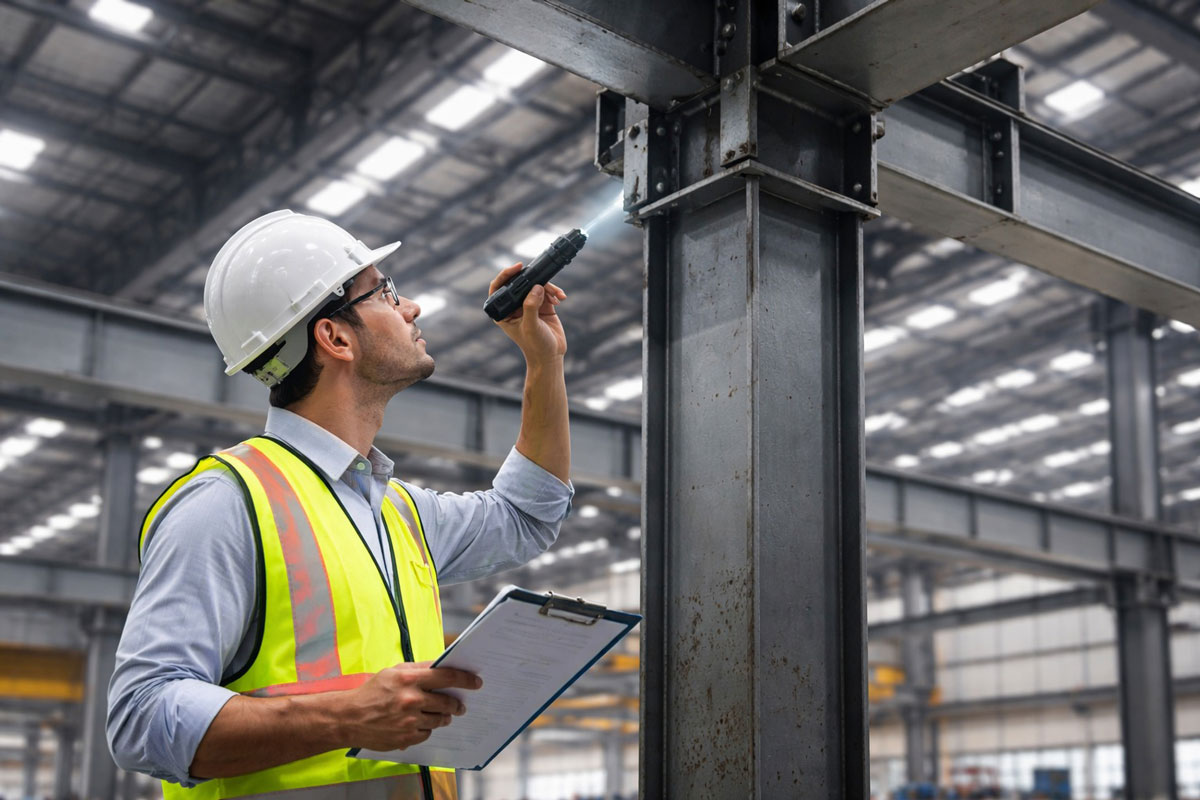
Engineers conduct a systematic inspection of all structural components (Columns, beams, slabs, and foundations):
- Identify visible defects and deterioration
- Assess structural condition and safety
- Signs of cracking, corrosion, or deformation
- Water ingress and material degradation
This stage helps identify early warning signs of structural distress.
2. Non-Destructive Testing (NDT)
Non-Destructive Testing (NDT) for RCC and steel structures is a method used to evaluate the quality, strength, and integrity of materials without causing any damage. In RCC, common NDT methods include Rebound Hammer Test, Ultrasonic Pulse Velocity (UPV) Test, Half-Cell Potential Test, Carbonation Test, Core Test and Chemical Test to assess concrete strength, uniformity, and corrosion of reinforcement. In steel structures, techniques like Ultrasonic Testing (UT), Magnetic Particle Testing (MT), Dye Penetration Testing (PT), and Radiographic Testing (RT) are used to detect cracks, weld defects, and internal flaws. NDT helps ensure structural safety, quality control, and maintenance planning.
Typical evaluations include:
- Concrete strength assessment
- Uniformity and integrity checks
- Corrosion probability analysis
These tests provide data-driven insights into the condition of the structure.
3. Structural Analysis and Load Evaluation
Structural Analysis and Load Evaluation is the process of assessing how a structure behaves under different types of loads such as dead load, live load, wind load, and seismic forces. It involves calculating stresses, forces, and deflections in structural members to ensure they are safe and stable. This evaluation helps determine whether a structure can safely carry the applied loads or requires strengthening or modification. This involves:
- Verifying load-bearing capacity
- Assessing impact of machinery or storage loads
- Evaluating structural adequacy for future expansion
This step ensures that the structure aligns with current and intended usage.
4. Usage and Functional Assessment
In many facilities, usage evolves over time. A structural audit evaluates whether:
- Floors are overloaded beyond design limits
- Equipment installation has altered load distribution
- Operational changes have introduced new risks
This is particularly important for warehouses and manufacturing units.
5. Risk Identification and Safety Review
The audit identifies potential structural risks such as:
- Progressive deterioration
- Localized weaknesses
- Overstressed structural members
Early identification helps prevent failures and unplanned shutdowns.
6. Repair, Strengthening, and Retrofitting Strategy
A key deliverable of the audit is a practical and prioritized action plan, including:
- Repair methodologies
- Structural strengthening solutions
- Retrofitting recommendations
These are aligned with operational feasibility and budget planning.
7. Structural Stability Certification
For compliance and operational purposes, the audit concludes with a structural stability certificate, where applicable. This is often required for:
- Regulatory approvals
- Insurance coverage
- Corporate safety compliance
Moving Beyond Cost: A Business-Centric Approach
For commercial and industrial stakeholders, structural audit decisions should not be driven purely by cost considerations. A limited-scope or superficial audit can lead to:
- Undetected structural risks
- Increased long-term maintenance costs
- Operational disruptions and safety incidents
Instead, the focus should be on:
- Depth of engineering analysis
- Relevance to operational conditions
- Quality and practicality of recommendations
Wire Consultancy’s Approach
Wire Consultancy delivers structural audits with a clear focus on industrial realities and commercial priorities. The approach is centered on:
- Engineering-driven assessments tailored to complex facilities
- Integration of advanced testing and analysis methods
- Minimal disruption to ongoing operations
- Actionable recommendations aligned with business continuity
The objective is to help organizations make informed decisions about their assets—ensuring safety, compliance, and long-term performance.
Structural audit cost in India varies based on multiple technical and operational factors, especially for commercial and industrial facilities. Rather than focusing on generic pricing, businesses should evaluate the scope, depth, and engineering rigor of the audit.
A well-executed structural audit is not just a compliance requirement—it is a strategic investment in safety, reliability, and operational efficiency.