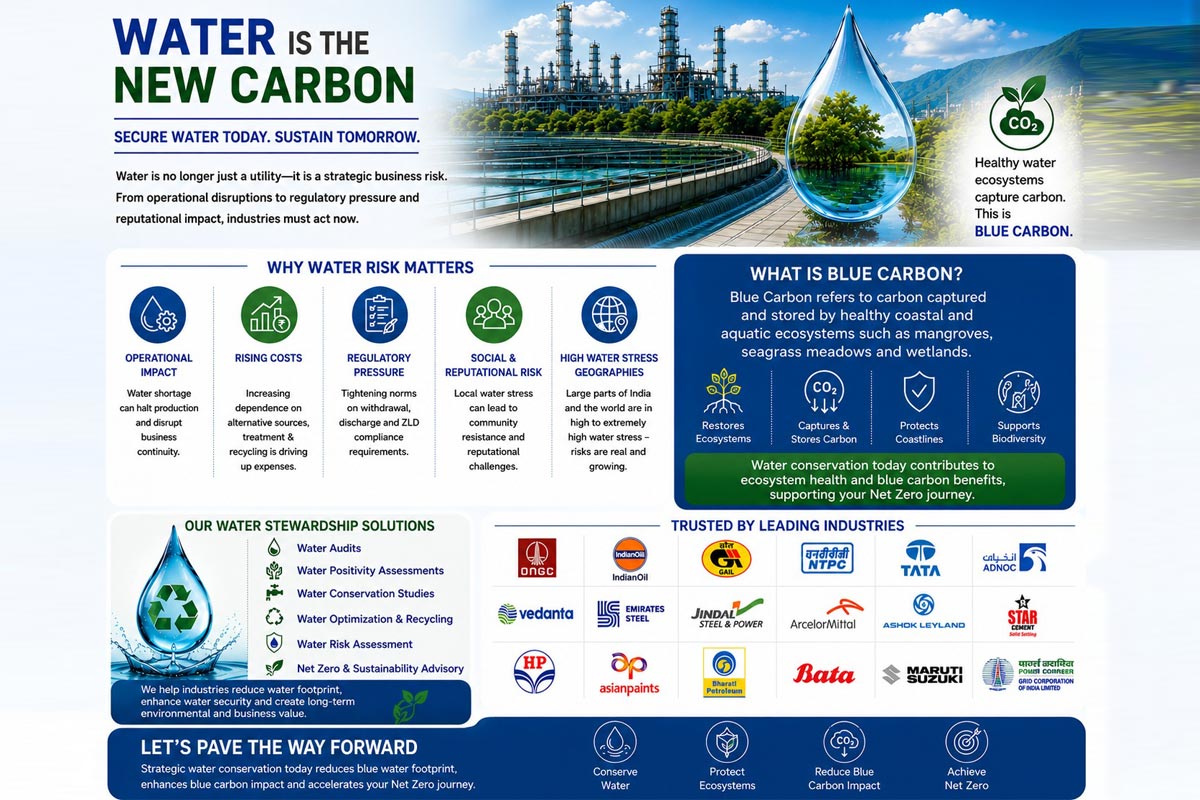
Most industries today have a reasonable handle on their energy consumption. Many have also started tracking emissions with increasing rigor. But when it comes to water, there is still a significant blind spot. Very few organizations truly understand their water footprint, let alone the risks associated with it.
Water is no longer just an environmental concern tucked away in sustainability reports—it is fast emerging as a core business risk. From operational disruptions to regulatory challenges and rising costs, water is beginning to influence decisions at the highest levels.
When Water Shortage Means Production Loss
For industries, water is not optional, it is fundamental to operations. And when supply becomes uncertain, the consequences are immediate.
In India, thermal power plants have already experienced shutdowns due to insufficient water availability for cooling. Similarly, textile clusters such as Tiruppur have faced production constraints driven by groundwater depletion and tightening environmental norms. On a global scale, even high-tech sectors like semiconductors and large-scale beverage manufacturing have flagged water scarcity as a material operational risk.
The equation is straightforward: without reliable water access, production continuity cannot be guaranteed.
From Low-Cost Resource to Strategic Expense
Historically, water has been treated as a low-cost utility. That assumption is rapidly becoming outdated.Industries are increasingly turning to alternative sources such as tanker supply, desalination, and advanced recycling systems to meet their needs. At the same time, investments in treatment infrastructure—such as Effluent Treatment Plants and Zero Liquid Discharge systems—are rising significantly. Disclosures through platforms like CDP highlight that companies are already facing substantial financial risks linked to water-related challenges.
What was once a negligible line item is now evolving into a strategic cost driver.
A Rapidly Tightening Regulatory Environment
Regulatory frameworks around water are becoming more stringent and more complex.In India, authorities such as the Central Pollution Control Board and the Ministry of Environment, Forest and Climate Change are enforcing tighter controls on both water withdrawal and discharge quality. Several industries are now required to comply with Zero Liquid Discharge norms, particularly in water-intensive sectors.
Globally, alignment with the United Nations Sustainable Development Goal 6 is pushing organizations to rethink how they manage water—not just as a compliance requirement, but as a shared and finite resource.
The direction is clear: regulation is moving beyond pollution control toward responsible resource stewardship.
Water as a Social and Reputational Risk
Unlike many other resources, water is deeply local. Its use is visible, immediate, and often contested.In regions facing scarcity, industrial water consumption has led to community resistance and, in some cases, operational disruptions. Companies in sectors such as beverages and manufacturing have encountered reputational challenges where local populations perceive inequitable access to water.
This is where water risk extends beyond environment and compliance—it becomes a matter of social license to operate.
Geographies Under Stress
The scale of the issue becomes clearer when viewed through a global lens. Tools developed by the World Resources Institute, such as the Aqueduct Water Risk Atlas, indicate that large parts of India and several major industrial regions worldwide fall under high to extremely high water stress.
With nearly a quarter of the global population living in such areas, businesses operating in these geographies are exposed to immediate and escalating risks.
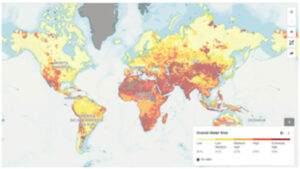
(Source: WRI Aqueduct)
A Fundamental Shift in Perspective
What we are witnessing is not just a change in metrics, but a shift in mindset.Organizations are moving from simply tracking how much water they use to understanding the risk associated with that use. At the same time, the focus is shifting from meeting minimum compliance standards to building long-term operational resilience.
The key question is no longer “How much water do we consume?” but rather,
“How secure and sustainable is our access to water?”
Industry Leadership is Already Emerging
Some organizations have already begun to lead this transition.
Thermax, through its “Sustaining the Blue” initiative, is actively fostering industry dialogue around responsible water use. Global players such as Coca-Cola are investing in water replenishment and watershed restoration programs, while Tata Steel has implemented extensive water recycling and zero-effluent discharge practices. Similarly, Unilever continues to focus on improving water efficiency across its value chain.
These efforts point to a broader trend: water stewardship is becoming a marker of leadership and competitive differentiation, not just compliance.
Why This Matters Now
Organizations that proactively address water risk stand to gain significantly. They are better positioned to avoid operational disruptions, manage costs more effectively, navigate regulatory changes, and build stronger relationships with communities and stakeholders.
Water, in many ways, is following the same trajectory that carbon did a decade ago—quietly moving from the margins to the center of strategic decision-making.
Wire Consultancy has successfully conducted water audits, water positivity assessments, and water conservation studies for leading industrial organizations across India. Through these engagements, we have enabled industries to identify water optimization opportunities, strengthen water stewardship practices, and implement sustainable conservation strategies aligned with their environmental and operational goals.
We look forward to partnering with organizations in advancing impactful water conservation initiatives, minimizing water footprint and blue carbon impact, and supporting their broader net-zero and sustainability journey.