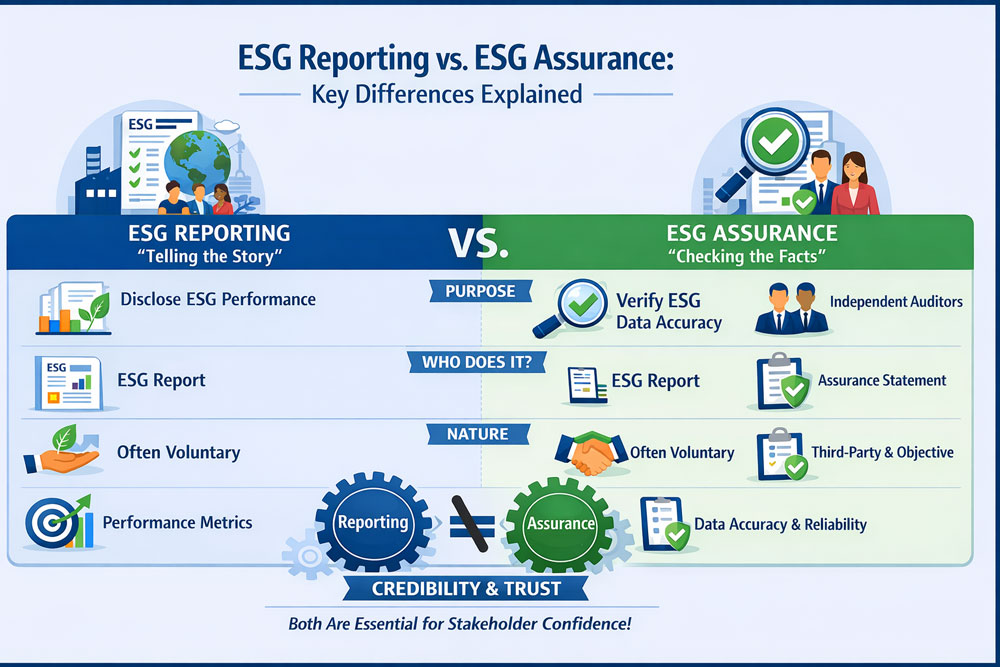
As businesses increasingly focus on sustainability and responsible operations, terms like ESG reporting and ESG assurance are becoming more common. While both are important parts of a company’s ESG journey, they are often confusing with respect to their requirement and reason for opting it . In reality, ESG reporting and ESG assurance serve different purposes, and understanding this difference is essential for companies that want to build credibility and trust with stakeholders.
ESG Report
ESG reporting is the process through which a company collects, analyzes, and shares information about its environmental, social, and governance performance on:
- E (Environmental): emissions, energy use, water, waste
- S (Social):labor practices, diversity, safety, community
- G (Governance): board structure, ethics, compliance
It is essentially a way for organizations to communicate how their operations impact areas such as the environment, employee well-being, and corporate governance. Companies typically include details like energy consumption, carbon emissions, workplace safety, diversity, and compliance practices in their ESG reports. These reports are usually prepared based on global frameworks such as GRI, SASB, or TCFD, which provide guidelines on what and how to disclose information. In simple terms, ESG reporting is about presenting the company’s sustainability data in a structured manner.
ESG Assurance
ESG assurance focuses on verifying the accuracy and reliability of the information presented in the ESG reports. It involves an independent review carried out by third-party experts who assess whether the ESG data is correct, consistent, and supported by proper evidence hence the following parameters are important to perform ESG Assurance:
- Conducted by Third Party experts/ auditors or certification bodies
- Ensures data is accurate, consistent, and credible
- Similar to financial audit but for non-financial data
During this process, the assurance provider examines how the data was collected, checks supporting documents, and evaluates& verify whether the company has followed the relevant reporting standards. The outcome of this process is an assurance statement, which gives stakeholders confidence that the ESG report can be trusted. It uses the standard like International Auditing and Assurance Standards Board – ISAE 3000 and AccountAbility – AA1000AS.
While ESG reporting tells the story of a company’s sustainability performance, ESG assurance confirms whether that story is credible.Hence when we talk about ESG reporting and assurancetogether, It helps companies build transparency, strengthen trust, and improve confidence among investors and stakeholders.
ESG (Environmental, Social, and Governance) is important for all sectors because it helps organizations manage risks, improve transparency, and build long-term sustainability. It enhances investor confidence by showing responsible and ethical business practices. ESG also ensures regulatory compliance as global standards are becoming stricter.It drives operational efficiency and cost savings, especially through energy and resource management. Overall, ESG strengthens brand reputation and competitive advantage in a rapidly evolving global market. Mentioning below few industrial sectors highlighted the sector specific ESG requirements and assurance need to strengthen their ESG reports.
Manufacturing & Heavy Industry
This sector has the highest environmental impact globally. ESG reporting focuses on emissions (Scope 1, 2, 3), energy use, and waste generation. Since data is complex and volume-heavy, ESG assurance plays a critical role in verifying fuel consumption, production output, and emission calculations. Globally, regulators and investors closely monitor this sector due to its carbon footprint.
Oil, Gas & Energy
One of the most regulated sectors worldwide, especially in Europe and the US. Companies report carbon emissions, methane leakage, and their transition to renewable energy. ESG assurance ensures that net-zero targets and transition claims are credible and not misleading. This sector faces strong pressure to decarbonize.
Financial Services
This sector’s impact is indirect but powerful. ESG reporting includes financed emissions and sustainable investments. Assurance validates ESG scoring models and green finance claims. Globally, this sector is crucial in preventing greenwashing and driving ESG adoption across industries.
Consumer Goods & Retail
This sector is heavily dependent on supply chains, often spread across multiple countries. ESG reporting focuses on labor practices, sourcing, and supplier transparency. ESG assurance verifies supplier compliance and ethical practices. The biggest global challenge here is data reliability from third-party suppliers.
IT & Technology
The main ESG focus is on energy consumption (data centers) and social factors like diversity. Reporting includes electricity usage, renewable energy sourcing, and e-waste. ESG assurance ensures that energy efficiency and renewable claims are accurate. Globally, this sector is moving toward 100% renewable energy commitments.
Transportation & Automotive
This sector is undergoing a major shift toward electric mobility (EVs). ESG reporting includes vehicle emissions, fuel efficiency, and EV adoption. ESG assurance validates emission testing data and sustainability claims. Governments worldwide are pushing strict emission norms, accelerating transformation.
Infrastructure & Real Estate
This sector focuses on green buildings and sustainable construction. ESG reporting includes energy efficiency, water use, and building materials. ESG assurance verifies green certifications and actual performance. Globally, frameworks like green building standards are driving growth in sustainable infrastructure.
The key difference between the two lies in their purpose and timing. ESG reporting is about disclosure, while ESG assurance is about validation. Reporting is usually handled internally or with the help of ESG consultants, whereas assurance is conducted by independent third parties to maintain objectivity. Reporting happens first, as companies need to prepare their ESG data before it can be reviewed. Assurance follows as a separate step to verify that the disclosed information is accurate and reliable. Together, they form a complete process that ensures both transparency and credibility.
The importance of having both ESG reporting and assurance has grown significantly in recent years. Investors and regulators are now paying closer attention to sustainability disclosures, and there is increasing pressure on companies to provide verified data. Without assurance, ESG reports may be seen as incomplete or unreliable, especially in cases where stakeholders suspect greenwashing. By adopting both practices, companies can improve investor confidence, enhance their ESG ratings, and stay prepared for evolving regulatory requirements.
However, many organizations face challenges in implementing these processes effectively. ESG data is often spread across multiple departments, making it difficult to maintain consistency. In some cases, companies lack proper systems for tracking sustainability metrics, which creates issues during verification. There is also a lack of standardization across industries, making it harder to compare ESG performance. These challenges highlight the need for a structured approach to ESG reporting, which ultimately makes the assurance process smoother and more efficient.
At Wire Consultancy, the focus is on helping organizations build strong ESG reporting foundations so that their data is accurate, well-structured, and ready for verification. This includes support in data collection, materiality assessment, framework alignment, and ESG disclosure preparation. By improving the quality of reporting, organizations can ensure that the assurance process becomes more streamlined and effective.
In conclusion, ESG reporting and ESG assurance are two distinct but interconnected elements of a company’s sustainability strategy. Reporting helps organizations communicate their ESG performance, while assurance ensures that this information is reliable and credible. Companies that invest in both are better positioned to build trust with stakeholders and demonstrate a genuine commitment to sustainable and responsible business practices.