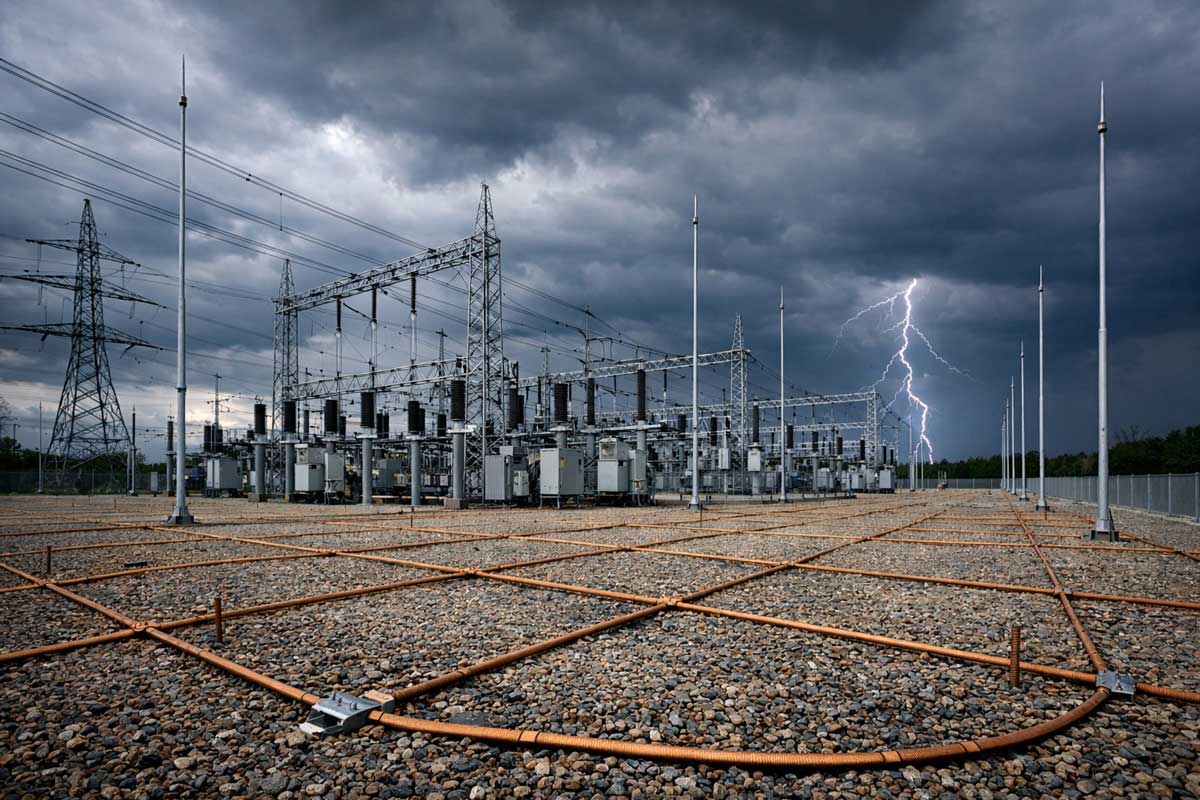
Power substations are among the most critical yet most exposed components of India’s electrical infrastructure. They operate silently, handling massive voltages and fault currents every second, often in open environments vulnerable to weather and external disturbances. When a substation fails, the impact is immediate—power outages, equipment damage, operational downtime, and in severe cases, loss of human life. At the heart of substation safety lie two systems that rarely attract attention until disaster strikes: earthing and lightning protection.
Why Power Substations Face Extreme Electrical Risk
Unlike enclosed electrical rooms, substations are designed to operate in open yards where equipment is directly exposed to atmospheric conditions. High-voltage transformers, circuit breakers, busbars, and gantries work together under enormous electrical stress. During faults or abnormal events, fault currents can rise to tens of kiloamperes within milliseconds.
In such conditions, electricity always seeks the path of least resistance. If a proper earthing system is not available, that path can pass through metallic structures, operating handles, fences, or even the human body. This is why substations are considered high-risk zones and why grounding is treated as a life-safety system rather than a design formality.
Earthing: The Foundation of Substation Safety
The primary purpose of earthing in a power substation is to safely dissipate fault current into the ground while keeping all exposed conductive parts at nearly the same electrical potential. This concept, known as equipotential bonding, is essential to prevent dangerous step and touch voltages.
When a ground fault occurs, the earthing system ensures that:
- The fault current flows through designed conductors instead of unintended paths
- Operators standing near equipment are not exposed to lethal voltage differences
- Protection systems operate correctly without delayed clearing
In Indian conditions, earthing design is particularly challenging. Soil resistivity can vary drastically within the same site due to rocky layers, moisture content, or chemical composition. Seasonal changes further affect earth resistance values, meaning an earthing system that appears adequate during commissioning may become unsafe years later.
This is why modern earthing design requires detailed soil resistivity measurements, fault current calculations, and grid modeling rather than rule-of-thumb practices.
The silent threat of step and touch voltage
Many electrical accidents in substations do not occur due to direct contact with live conductors. Instead, they occur because of step and touch voltages during fault conditions. Step voltage refers to the potential difference between a person’s feet, while touch voltage refers to the difference between a grounded object and the ground beneath a person.
During an earth fault, these voltages can reach fatal levels if the earthing grid is not properly designed or maintained. Crushed stone layers, ground coverage, and conductor spacing all play a critical role in controlling these risks, yet they are often overlooked during modifications or expansions.
Lightning Protection: Managing a natural but predictable hazard
India experiences high lightning activity across many regions, particularly during monsoon seasons. Power substations, with their tall structures and exposed conductors, naturally attract lightning strikes. A direct strike or even a nearby lightning event can inject extremely high transient currents into the system.
Lightning protection systems are designed to intercept lightning strikes and safely conduct the energy to earth without passing through critical equipment. This typically involves air terminals, down conductors, and their integration with the substation earthing grid. However, protection is only effective when all components work as a single coordinated system.
Poor bonding between lightning protection and earthing systems often leads to flashovers, insulation breakdown, and damage to control and protection panels. In modern substations with digital relays and SCADA systems, the impact of lightning-induced surges is even more severe.
Why Standards Matter—but only when applied correctly
International standards such as IEEE 80 and IEC 62305 provide well-established methodologies for earthing and lightning protection design. However, compliance on drawings does not always translate to safety on the ground. Over time, substations undergo multiple changes—new feeders are added, layouts are modified, and fault levels increase due to network strengthening.
Without periodic evaluation, earthing systems can become inadequate without anyone realizing it. Corrosion of buried conductors, broken connections, or undocumented alterations slowly degrade performance while the risk continues to grow.
The need for periodic assessment, Not just installation
Earthing and lightning protection systems are not “install and forget” solutions. Their effectiveness must be verified through regular testing, analysis, and review. This is especially important for older substations that were designed using outdated assumptions or simplified methods.
A structured assessment helps identify gaps such as:
- Unsafe step and touch voltage levels
- Inadequate earth resistance under fault conditions
- Ineffective lightning interception coverage
- Poor bonding between systems
- Improperly coordinated Surge Protection Measures
Addressing these issues proactively is far more cost-effective than responding to a major failure or accident.
How Wire Consultancy Helps
Wire Consultancy supports utilities, industries, and infrastructure operators by providing earthing system studies, lightning protection assessments, and substation safety audits. Their role is strictly consultative, focusing on risk evaluation, design validation, and compliance with IEEE and IEC standards, without engaging in installation or maintenance activities. By identifying hidden vulnerabilities and offering practical engineering recommendations, Wire Consultancy helps ensure that power substations remain safe for personnel, reliable for operations, and resilient against both electrical faults and lightning events.