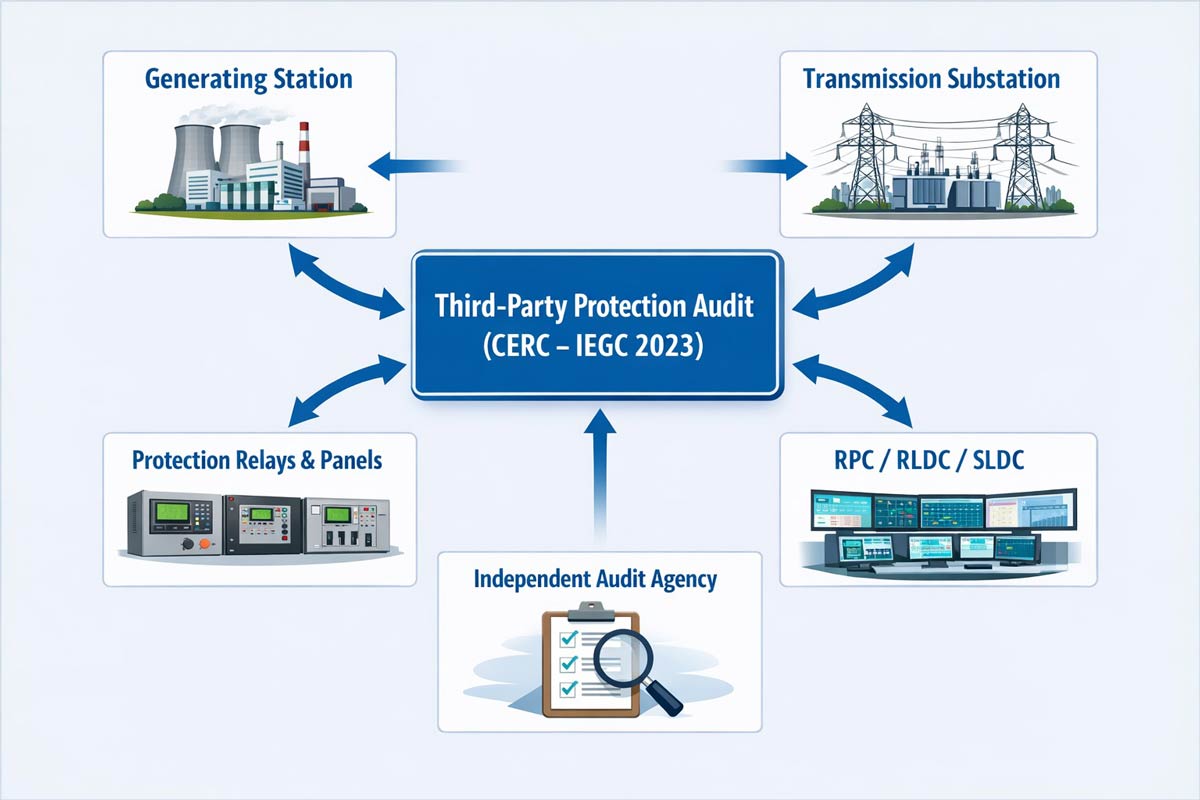
In the rapidly evolving power sector, protection systems at substations and other grid elements play a critical role in safeguarding network integrity, maintaining stability, and minimizing the impact of faults. The Central Electricity Regulatory Commission (CERC) mandates a systematic Protection Audit Plan under the Indian Electricity Grid Code (IEGC) Regulations, 2023, which includes periodic third-party protection audits. This regulatory requirement ensures that protection systems are independently evaluated, deficiencies identified, and corrective action plans implemented in a time-bound manner.
Regulatory Framework and Applicability
The IEGC 2023, issued by CERC, explicitly integrates protection system audits as part of broader grid operational standards. All users connected to the grid at 220 kV and above (and 132 kV and above in the North Eastern Region) are subject to these audit requirements.
Key regulatory requirements include:
- Annual Internal Audit: Users must conduct an internal audit of their protection systems yearly and report any shortcomings, along with corrective action plans, to their respective Regional Power Committee (RPC).
- Third-Party Protection Audit: Independent third-party protection audits are required once every five years for each eligible substation or earlier if directed by the RPC.
- Post-Event Audit Triggers: RPCs can mandate additional third-party audits for specific generating stations or substations following significant grid events or operational anomalies. The audit must then be completed within three months of such advisories.
Scope of Third-Party Protection Audit
A third-party protection audit involves an unbiased evaluation of protection systems — from relay settings to operation coordination — by a qualified independent agency. While CERC mandates the framework, the detailed audit checklist and reporting format are specified in Annexure-1 of the IEGC Regulations, ensuring consistency and completeness of audit outputs.
Typical audit scope includes but is not limited to:
- Review of Protection Philosophy and Scheme Design: Verification of protection settings against design intent, coordination studies, and grid code requirements.
- Relay and Protection Device Evaluation: Field verification of relay configuration, event log analysis, and functional testing.
- System Coordination Assessment: Validation of protection coordination between adjacent zones, feeders, and transformer bays to prevent mis-operations.
- Documentation and Record Verification: Ensuring that protection setting records, logic diagrams, and configuration logs are up to date and traceable.
- Corrective Action Recommendations: Identification of deficiencies and formulation of practicable corrective measures with priorities and timelines.
Deliverables and Reporting
The third-party audit agency is typically required to furnish two reports:
- Preliminary Report: Prepared on-site immediately after the audit activities and agreed upon by stakeholders present.
- Detailed Audit Report: A comprehensive document prepared post-audit that includes findings, analysis, and recommendations. This report must be submitted within the timeline specified by the RPC/IEGC — generally within one month of audit completion.
These reports, accompanied by corrective action plans, are submitted to the respective RPC and the relevant Load Despatch Centre (RLDC/SLDC). Utilities are expected to follow up on the compliance of recommendations and report progress regularly.
Benefits of Third-Party Protection Audits
Adherence to CERC’s third-party protection audit regime yields multiple strategic and operational advantages:
- Enhanced Grid Reliability: Independent audits identify latent protection issues that might compromise grid stability during faults.
- Regulatory Compliance: Timely completion and submission of audit reports demonstrate compliance with IEGC requirements, reducing regulatory risk.
- Reduced Outages and Mis-operations: Systematic review of relay settings and coordination reduces the probability of unnecessary tripping and cascading outages.
- Improved Operational Confidence: Independent validation of protection settings builds confidence among stakeholders, including utilities, RPCs, and regulatory bodies.
Implementation Challenges and Best Practices
Implementing third-party protection audits entails challenges such as aligning audit schedules with operational availability, securing qualified audit agencies, and translating audit findings into actionable corrective plans. Best practices include:
- Establishing a Protection Audit Calendar aligned with the five-year cycle and internal audit schedule.
- Selecting auditing firms with proven expertise in high-voltage protection systems and grid code compliance.
- Developing internal processes to implement corrective actions promptly and document compliance.
- Leveraging audit findings for ongoing training of protection engineers and relay technicians.
CERC’s Third-Party Protection Audit requirement is a crucial element of the Indian power sector’s governance framework, driving both compliance and operational excellence. By adhering to the specified audit cycles, maintaining transparent reporting, and proactively addressing identified deficiencies, utilities can significantly enhance protection reliability and contribute to a more resilient national grid. For consultancies like Wire Consultancy, supporting clients through this entire lifecycle — from audit planning to reporting and compliance — offers both strategic value and operational impact.