
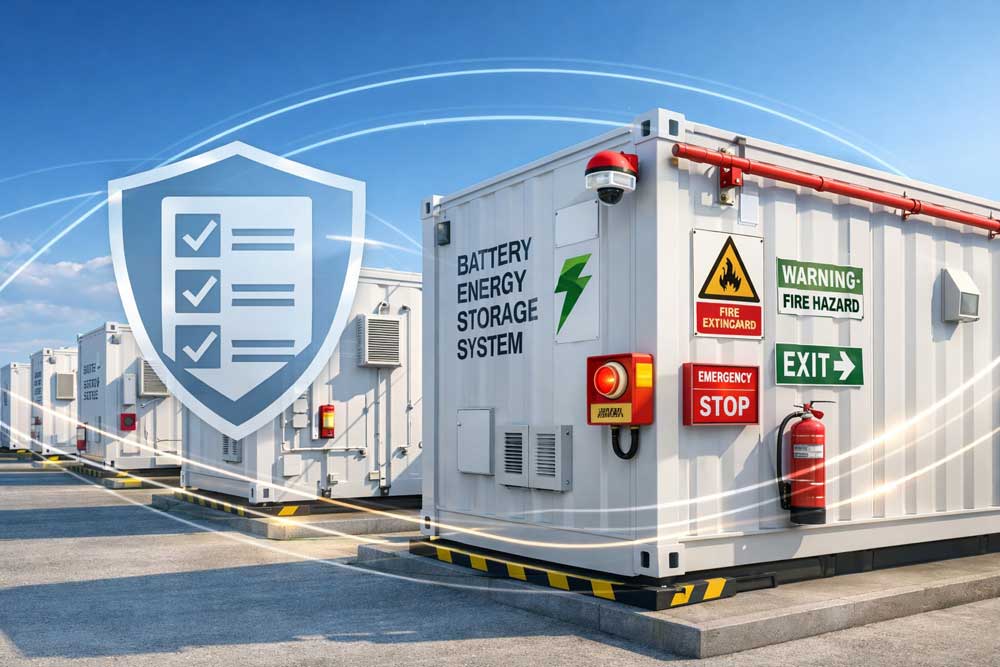
Why independent fire safety audits are becoming critical for safe, reliable, and future-ready battery energy storage systems
Battery Energy Storage Systems (BESS) are no longer experimental infrastructure. Across India, they are being deployed at grid scale, integrated with renewable energy projects, and installed at substations and industrial facilities to stabilize power supply. As energy storage becomes central to the country’s energy transition, one question is gaining urgency: are these systems fire-safe?
Recent global incidents involving battery fires have shown that when things go wrong in a BESS installation, the consequences can be severe. Fires escalate quickly, suppression is complex, and the impact extends beyond equipment damage to human safety, grid reliability, and public confidence. Recognizing this reality, Indian regulators have moved toward a more structured approach, introducing the concept of mandatory independent third-party fire safety audits for BESS projects.
Why Fire Safety in BESS Requires Special Attention
Unlike conventional electrical systems, battery energy storage systems store large amounts of energy in a compact space. Lithium-ion and similar battery technologies carry an inherent risk of thermal runaway, a condition where a single cell failure can trigger a chain reaction across modules, racks, and even entire containers.
Once initiated, a battery fire behaves very differently from a typical electrical fire. It can produce intense heat, toxic gases, and internal pressure buildup, often making conventional firefighting methods ineffective. In several international cases, fires have reignited hours or even days after appearing to be extinguished.
This unique risk profile means that traditional fire safety checks are not sufficient for BESS installations. Fire safety must be examined holistically — from design and layout to detection, suppression, and emergency response.
The Shift toward Independent Fire Safety Audits
The draft Standard Operating Procedure issued by the Central Electricity Authority (CEA) marks a significant shift in how BESS fire safety is viewed. It clearly emphasizes the role of independent third-party fire safety audits, conducted by qualified auditors through empanelled agencies.
The logic is straightforward. Fire safety assessments carried out internally or solely by equipment suppliers may not always capture system-level risks or operational blind spots. An independent audit introduces objectivity, technical depth, and accountability.
More importantly, the audit is not positioned as a one-time approval activity. It is meant to be a lifecycle-based safety mechanism, covering pre-commissioning, periodic operation, and post-incident scenarios.
What a BESS Fire Safety Audit Actually Examines
A well-conducted fire safety audit goes far beyond visual inspection. It is a structured evaluation of how effectively fire risks have been anticipated and controlled across the installation.
Documentation and Preparedness
Auditors begin by examining whether the foundation of safety management is in place. This includes checking the availability of operation and maintenance manuals, emergency response plans, hazard mitigation studies, and maintenance records. The presence of documented procedures, regular drills, and coordination with local fire authorities often indicates how seriously fire safety is treated on-site.
Layout and Design Decisions
Many fire incidents can be traced back to poor layout choices made early in a project. Audits assess whether adequate spacing exists between BESS containers and nearby structures, whether fire-rated separations or alternative mitigation measures are provided, and whether ventilation and thermal management systems are appropriately designed.
These design elements directly influence how a fire behaves and whether it can be contained.
Detection Systems and Early Warning
In BESS installations, early detection is critical. Auditors review the type, placement, and testing history of fire and gas detection systems at multiple levels — cell, module, rack, container, and site level. Detection delays of even a few minutes can drastically reduce the effectiveness of suppression systems.
Fire Suppression and Protection Measures
Suppression strategies for battery fires must be carefully selected and validated. Audits examine whether automatic suppression systems are installed, whether they are designed based on relevant testing data, and whether manual activation options are available. Supporting infrastructure such as fire-water systems, pumps, hydrants, and portable extinguishers is also reviewed for accessibility and reliability.
Personnel Safety and Emergency Response
Battery fires pose serious risks to human health due to toxic gas release. Auditors therefore check the availability and condition of gas masks, respiratory equipment, first-aid facilities, and clearly displayed emergency contact information. These elements are essential not only for compliance but for protecting lives during an actual emergency.
Fire Safety Audits across the BESS Lifecycle
One of the most important aspects of the emerging framework is its emphasis on audit frequency. Fire safety is not treated as a one-time checkbox before energization.
Audits are expected at the pre-commissioning stage, before first energization approval. Periodic audits are required during operation to ensure that systems remain safe as they age or as operating conditions change. In addition, special audits are mandated after major modifications or any fire incident.
This lifecycle approach reflects a practical understanding of how risks evolve over time.
Beyond Compliance: The Real Value of Fire Safety Audits
While regulatory compliance is a key driver, organizations that view fire safety audits only as an approval requirement often underestimate their value.
A strong fire safety audit can:
- Prevent catastrophic asset loss and prolonged outages
- Reduce insurance exposure and improve risk ratings
- Protect operating personnel and emergency responders
- Strengthen investor and stakeholder confidence
- Support long-term grid stability and project reliability
In large BESS projects, a single fire incident can undermine years of investment and planning. From a business perspective, proactive fire safety auditing is a form of risk insurance.
How Wire Consultancy Supports BESS Fire Safety Audits
Wire Consultancy works with BESS owners, developers, and operators to help them navigate the growing expectations around fire safety audits with clarity and confidence.
Our role is not limited to compliance support. We focus on risk-based, practical fire safety readiness for BESS projects.
Our consultancy support includes:
- Pre-audit fire safety readiness assessments to identify gaps before formal third-party audits
- Technical review of BESS fire safety measures aligned with evolving regulatory and industry standards
- Support during independent third-party audits, including documentation preparation and technical clarification
- Action-oriented recommendations, helping clients translate audit findings into implementable improvements
- Post-audit compliance support, ensuring corrective actions are properly addressed and sustained
Wire Consultancy operates strictly as a consultancy and advisory partner. We do not undertake installation or maintenance work, allowing us to maintain independence, objectivity, and conflict-free technical advice.
As battery energy storage becomes critical infrastructure, fire safety can no longer be treated as an engineering afterthought. The regulatory direction is clear: independent fire safety audits will play a central role in ensuring safe and reliable BESS deployment in India.
Organizations that embrace this shift early will not only stay ahead of compliance requirements but will also protect their people, assets, and long-term business interests.
In BESS projects, fire safety audits are no longer just about meeting regulations. They are about preventing risk before it becomes reality.