Field-tested insights from sustainability professionals
Introduction
As Environmental, Social, and Governance (ESG) reporting transitions from a voluntary best practice to a regulatory expectation, the question is no longer whether companies should publish sustainability disclosures, it is whether those disclosures are credible. Investors managing trillions in assets, regulators across the EU, UK, and Asia-Pacific, and increasingly discerning customers all want assurance that the numbers behind a company’s sustainability narrative are real, consistent, and supported by verifiable evidence.
The answer to this demand is independent ESG verification which is a structured, evidence-based review process that subjects a company’s sustainability data, methodologies, and governance practices to the same level of scrutiny applied to financial statements. In essence, if a financial audit tells you whether the books are accurate, an ESG verification tells you whether the sustainability story is true.
This platform offers a practitioner’s perspective on how ESG verification works in practice, not just as a procedural overview, but as a field-informed account drawn from real engagements across manufacturing, financial services, energy, and consumer goods sectors. Whether you are preparing your first ESG report or seeking to strengthen an existing programme, understanding the verification process is the most direct path to reporting that your stakeholders can trust.
Why ESG Verification Matters
Publishing an ESG report is no longer sufficient on its own. Without independent verification, the most comprehensive sustainability disclosure remains vulnerable to scepticism. Stakeholders are increasingly sophisticated and institutional investors use specialist ESG data providers to cross-reference reported figures; NGOs scrutinise supply chain disclosures for inconsistencies; and regulators in the EU (under CSRD) and the UK (under the FCA’s Sustainability Disclosure Requirements) are moving towards mandatory assurance requirements.
The presentation of a company’s sustainability practices as more environmentally or socially responsible than they actually are and has become a significant legal and reputational risk. High-profile enforcement actions in Europe and North America have put boardrooms on notice: sustainability claims that cannot be substantiated by independent evidence carry real consequences.
Verification addresses these risks directly. Beyond the defensive value of assurance, companies that undergo verification consistently report a secondary benefit: the process itself drives internal improvement. The discipline of preparing data for external scrutiny compels organisations to rationalise data collection systems, close reporting gaps, and bring sustainability governance into alignment with board-level expectations.
| WHY IT MATTERS — AT A GLANCE
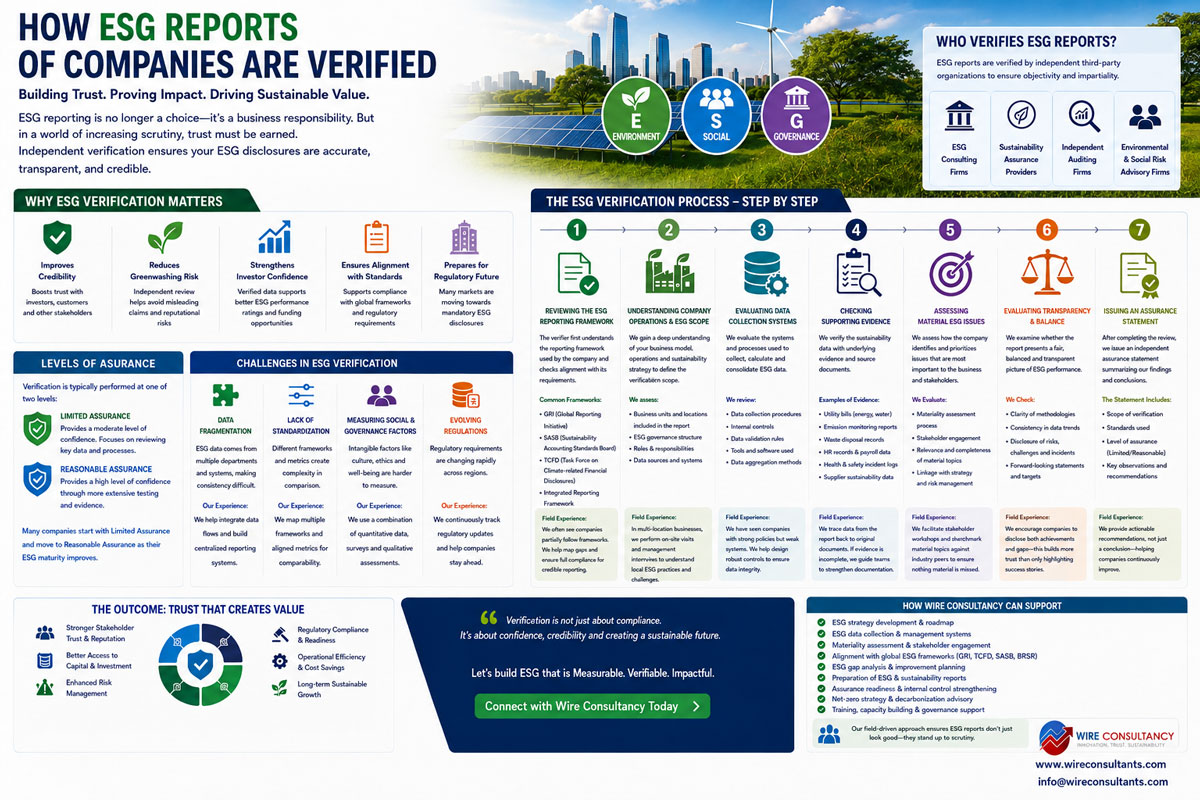
Verified ESG disclosures improve credibility with investors and lenders · Reduce exposure to greenwashing accusations and regulatory enforcement · Strengthen alignment with GRI, SASB, TCFD, and Integrated Reporting · Build long-term confidence across stakeholder groups · Support readiness for mandatory disclosure regimes now taking effect globally |
Who Verifies ESG Reports?
ESG reports are verified by independent third-party organisations whose primary role is to provide an objective, unbiased assessment of a company’s sustainability disclosures. The choice of verifier matters: it should reflect the scope of reporting, the sophistication of the company’s data systems, and the expectations of its primary stakeholder audiences.
Verifiers typically fall into several categories: specialist sustainability assurance providers with deep sector expertise; established auditing and professional services firms offering sustainability assurance as part of a broader practice; and advisory firms with technical competence in environmental measurement, social impact assessment, and governance frameworks.
A common observation from the field is that companies selecting a verifier solely on the basis of existing relationships — for instance, engaging their financial auditor to conduct ESG verification without assessing specialist capability; sometimes find that the process lacks the depth of scrutiny their more demanding stakeholders expect. The most effective verifications are conducted by teams that combine technical sustainability expertise with assurance methodology, not simply auditing credentials applied to a new subject matter.
The ESG Verification Process — Step by Step
While the precise methodology may vary depending on the reporting framework, the size and complexity of the organisation, and the level of assurance being sought (limited or reasonable), ESG verification consistently follows a structured sequence of activities. Below, we outline each step with both technical explanation and field-informed insight.
| 1 | Reviewing the ESG Reporting Framework
Every ESG verification begins with a thorough review of the reporting framework or combination of frameworks the company has chosen to follow. The most widely used international standards include the Global Reporting Initiative (GRI), the Sustainability Accounting Standards Board (SASB), the Task Force on Climate-related Financial Disclosures (TCFD), and the Integrated Reporting Framework. The verifier’s first task is to confirm that the company’s disclosures are materially consistent with the disclosure requirements of the chosen frameworkincluding which metrics must be reported, how they should be calculated, and what contextual information should accompany them. Where multiple frameworks are used, verifiers also check that disclosures do not conflict across frameworks. This step establishes the audit scope and provides the reference point against which all subsequent evidence will be assessed. 🔍 Field Insight In one engagement with a mid-sized industrial manufacturer, we found that the company had selected TCFD as its primary framework but had not conducted a formal climate scenario analysis which is a core TCFD requirement. The ESG report made no reference to this gap. Identifying this at the outset allowed the company to address the omission before publication, significantly strengthening the credibility of its climate-related disclosures. |
| 2 | Understanding Company Operations and ESG Scope
Before any data is reviewed, the assurance team conducts a structured assessment of the company’s operational profile and sustainability governance. This encompasses the geographic and legal scope of reporting like which subsidiaries, facilities, and business units are included as well as the organisational boundaries applied (financial control, operational control, or equity share). This step also involves understanding how ESG responsibilities are distributed within the organisation. Sustainability data rarely originates in a single department; it flows from operations teams tracking energy and water consumption, HR functions managing workforce metrics, procurement managing supplier standards, and finance overseeing governance practices. A clear mapping of these data sources is essential, because inconsistencies between departmental records and reported figures are among the most common findings in ESG verifications and often the most damaging to report credibility. 🔍 Field Insight During a verification engagement for a services firm, we discovered that two recently acquired subsidiaries had been included in the narrative sections of the ESG report — prominently featured in community investment stories but excluded from the quantitative data tables due to an oversight in defining the reporting boundary. This misalignment, though unintentional, was precisely the kind of inconsistency that stakeholders and ESG rating agencies are trained to identify. |
| 3 | Evaluating Data Collection Systems
A critical and often underestimated phase of ESG verification is the assessment of the systems, tools, and processes the company uses to collect and manage sustainability data. Verifiers examine whether there are documented procedures for data collection, defined responsibilities for each metric, and internal controls to detect and correct errors. Common metrics subject to system evaluation include energy consumption (by source and facility), Scope 1, 2, and 3 greenhouse gas emissions, water withdrawal and discharge, lost-time injury frequency rate (LTIFR) and other safety metrics, employee headcount by gender, level, and region, and supply chain sustainability indicators. Companies using integrated ERP platforms, IoT-enabled metering systems, or dedicated ESG data management software typically present more auditable and reliable data trails than those relying on manual spreadsheets consolidated at year-end. The latter approach, while common, introduces significant risks of aggregation error, version control issues, and undocumented assumptions. 🔍 Field Insight In one engagement in the IT sector, we found that Scope 2 electricity emissions had been calculated using a single national average grid emission factor applied uniformly across facilities in six different countries including some where the company had entered into renewable energy contracts that would have materially reduced the reported figure. Correcting the methodology reduced the company’s reported Scope 2 emissions by 34%. The error was not deliberate; it was a system design gap that verification brought to light. |
| 4 | Checking Supporting Evidence
Once data systems have been assessed, verifiers examine the documentary evidence behind specific figures reported in the ESG disclosure. This involves tracing reported metrics back to primary source documents, the underlying records from which figures were derived. Evidence reviewed typically includes utility invoices for energy and water consumption, third-party environmental monitoring reports, HR information system extracts for workforce statistics, waste transfer notes and disposal documentation, internal audit reports and board committee minutes for governance metrics, and supplier questionnaire responses for supply chain indicators. The standard applied is traceability: can every reported figure be traced, without ambiguity, to a reliable and contemporaneous source record? Where figures rely on estimation methodologies as is common for certain Scope 3 emissions categories. Verifiers assess whether the estimation approach is reasonable, consistently applied, and transparently disclosed. 🔍 Field Insight During an engagement of a logistics company’s ESG report, we requested the supporting evidence behind a reported figure for employee training hours; a metric the company had highlighted as a key performance indicator. The HR team provided a spreadsheet, but when we traced specific entries to training records, we found that the methodology had changed mid-year: the first half counted only formal instructor-led training, while the second half included e-learning modules of any duration. The resulting figure was technically accurate as computed, but methodologically inconsistentand the report contained no disclosure of this change. Transparency was added at our recommendation. |
| 5 | Assessing Material ESG Issues
Most ESG reports are structured around a set of material issues.The sustainability topics considered most significant to the organisation’s long-term value creation and its relationships with key stakeholders. A structured materiality assessment is the foundation of credible ESG reporting; it demonstrates that the report reflects genuine priorities rather than selective disclosure of positive performance. Verifiers assess whether the company conducted a documented materiality process, how stakeholder groups were engaged, how issues were scored and prioritised, and whether the final selection of material topics is consistent with the company’s sector, operating context, and peer reporting. They also examine whether the report adequately addresses all topics identified as material — including those where performance is weak. Common material issues across sectors include climate transition risk and physical climate risk, supply chain human rights and labour standards, employee health, safety and wellbeing, data privacy and cybersecurity governance, board diversity and executive pay governance, and biodiversity and water stewardship. 🔍 Field Insight In one engagement with a consumer goods company, the materiality matrix presented in the ESG report ranked supply chain labour standards as a top-tier material issue. However, the report’s substantive disclosure on this topic comprised two paragraphs and a single supplier code of conduct reference with no data on audit coverage, non-conformances identified, or corrective action rates. The mismatch between stated materiality and depth of disclosure was a credibility risk that the verification process identified and the company subsequently addressed. |
| 6 | Evaluating Transparency and Balance
Credible ESG reporting does not only present achievements. Verifiers assess whether the report provides a balanced and transparent account of the company’s sustainability performance including areas where progress has been slower than planned, targets that were missed, or operational incidents that had material impacts. This involves examining whether calculation methodologies are clearly explained and consistently applied across reporting periods, whether year-on-year performance trends are accurately presented without selective benchmarking, whether restatements of prior-year data (due to methodology changes, acquisitions, or corrections) are clearly flagged, and whether negative incidentssignificant safety events, environmental spills, governance failures are disclosed with appropriate context. A report that presents only positive performance narratives while omitting or minimising adverse developments will not withstand scrutiny from experienced investors, rating agencies, or regulators. Transparency about challenges, accompanied by clear remediation plans, is consistently viewed more favourably than a curated account of successes. 🔍 Field Insight In an engagement with a ship breaking sector company that had experienced one significant safety incidents during the reporting year, which was publicly documented in local regulatory filings. The initial draft ESG report made no reference to either incident. When we raised this during the verification process, the response from the sustainability team was that ‘the legal team had advised caution.’ Our position was clear: omitting material incidents that were already in the public domain created far greater reputational risk than transparent disclosure with a remediation narrative. The incidents were included in the final report. |
| 7 | Issuing the Assurance Statement
Upon completion of the verification process, the assurance body prepares a formal ESG assurance statement. This document is typically published as part of the ESG report and serves as the primary communication to external stakeholders regarding the scope, methodology, and conclusions of the verification. The assurance statement specifies the scope of work — which sections of the report and which metrics were subject to verification; the assurance standard applied (commonly AA1000AS, ISAE 3000, or ISAE 3410 for greenhouse gas emissions); the level of assurance provided (limited or reasonable); and the key observations, findings, and recommendations arising from the process. A limited assurance statement expresses that nothing came to the verifier’s attention indicating material misstatement which is a negative form of assurance. Reasonable assurance provides a positive conclusion that the information is presented fairly, in all material respects, and carries a higher evidential threshold. Companies with mature ESG data systems are increasingly seeking reasonable assurance to meet the expectations of institutional investors. 🔍 Field Insight One of the most common questions we receive from corporate sustainability teams is: ‘What will the assurance statement say if we have unresolved data gaps?’ The honest answer is that professional verifiers will reflect their findings accurately. In practice, the most effective approach is to disclose known limitations proactively within the report itself, Explaining the gap, its cause, and the steps being taken to close it. Verifiers consistently view proactive disclosure of limitations more favourably than gaps discovered during fieldwork. |
Challenges in ESG Verification
Despite growing adoption, ESG verification presents a number of practical challenges; both for the companies being verified and for the assurance providers conducting the work. Understanding these challenges in advance allows companies to invest in the right capabilities before the verification process begins.
| Data Fragmentation Across the Organisation
ESG data originates across multiple departments, systems, and geographies. Energy data may sit in facility management systems; HR data in a separate HRIS; procurement data in supplier portals. Consolidating this data into a single, consistent reporting datasetwith clear audit trails is frequently the most time-consuming aspect of ESG reporting preparation. Organisations that invest in integrated ESG data platforms consistently find the verification process faster, less disruptive, and more likely to result in clean assurance outcomes. |
| Absence of Universal Reporting Standards
Unlike financial reporting, which operates within well-established regulatory frameworks, ESG reporting standards remain fragmented and continue to evolve. While the ISSB’s release of IFRS S1 and IFRS S2 represents a significant step toward convergence, companies operating across multiple jurisdictions still navigate overlapping and sometimes conflicting disclosure requirements. Verifiers must therefore apply professional judgement in assessing the appropriateness of methodologies a task that requires genuine sector expertise, not just audit process familiarity. |
| Quantifying Social and Governance Performance
Environmental metrics like greenhouse gas emissions, energy consumption, water withdrawal lend themselves to quantitative measurement and established calculation methodologies. Social and governance indicators are considerably more complex. How does one measure the effectiveness of a speak-up culture, the quality of board decision-making, or the lived experience of workers in a supply chain? Verifiers increasingly rely on qualitative assessment methodologies, including document review, management interviews, and facility visits, to provide assurance over these dimensions. |
| Scope 3 Emissions: The Frontier of ESG Verification
An emerging and increasingly significant challenge is the verification of Scope 3 greenhouse gas emissions: indirect emissions occurring across a company’s value chain, including purchased goods, business travel, product use, and end-of-life disposal. Scope 3 emissions frequently account for 70–90% of a company’s total carbon footprint, yet they are the hardest to measure accurately and the most dependent on estimation methodologies and supplier data. Regulatory frameworks including the EU’s CSRD are beginning to mandate Scope 3 disclosure, making the development of credible, auditable Scope 3 methodologies a business-critical priority. |
How Wire Consultancy Supports ESG Reporting
Wire Consultancy supports organisations at every stage of the ESG reporting journey starting from building the foundational data systems and governance structures that make reporting credible, to preparing publicationready sustainability reports aligned with the frameworks that matter most to your investors and regulators.
Our approach is deliberately practical. We do not begin with framework selection or report design; we begin with data. A sustainability report is only as credible as the information that underpins it, and our engagements consistently focus first on ensuring that clients have the data collection systems, internal controls, and documentation disciplines in place to withstand external scrutiny: whether that scrutiny comes from an independent verifier, an institutional investor, or a regulatory examiner.
Our team brings together sustainability assurance professionals, environmental scientists, corporate governance specialists, and sector experts who have collectively conducted ESG advisory and verification work across manufacturing, Energy, financial services, infrastructure, consumer goods, and technology sectors.
| Service Area | What We Deliver |
| ESG Data Collection & Management | Design and implement robust data collection systems across all operational units, ensuring consistency, traceability, and audit-readiness. |
| Materiality Assessment | Conduct structured stakeholder engagement exercises to identify and prioritise the ESG topics that matter most to your business and investors. |
| Framework Alignment | Map your disclosures to GRI, SASB, TCFD, or Integrated Reporting or a combination depending on your regulatory context and investor expectations. |
| ESG Gap Analysis | Benchmark your current reporting practices against leading frameworks and peer companies, and develop a prioritised improvement roadmap. |
| Report Preparation | Draft or co-author your ESG or Sustainability Report to the highest professional standard, ready for independent verification. |
| CLIENT OUTCOME — ILLUSTRATIVE EXAMPLE
An IT group engaged Wire Consultancy following investor feedback that its ESG disclosures lacked the specificity and rigour expected by institutional capital. Over an eight-month engagement, we redesigned the company’s ESG data collection across 12 facilities, conducted a stakeholder-informed materiality assessment, and prepared a GRI-aligned sustainability report that successfully obtained limited assurance from an independent verification body. The company’s ESG rating improved in the subsequent annual assessment cycle. |
To explore how Wire Consultancy can support your organisation’s ESG reporting and verification programme, contact our sustainability advisory team at info@wireconsultants.com or visit www.wireconsultants.com.
Conclusion
Independent ESG verification is no longer a differentiating feature of leading-practice sustainability reporting. It is rapidly becoming the baseline expectation for organisations operating in markets where investors, regulators, and customers take sustainability performance seriously. As mandatory disclosure regimes expand, the question for most corporate sustainability teams is not whether to pursue verification, but how to ensure that their data systems, governance structures, and reporting practices are ready for it.
The verification process, at its best, is not an adversarial exercise. It is a collaborative discipline that helps organisations discover and address the gaps between their sustainability intentions and the evidence required to substantiate them. Companies that approach verification as an investment in long-term credibility rather than a compliance obligation, consistently reporting practicesstrengthen stakeholder relationships, greater investor confidence, and a more resilient sustainability governance culture.