
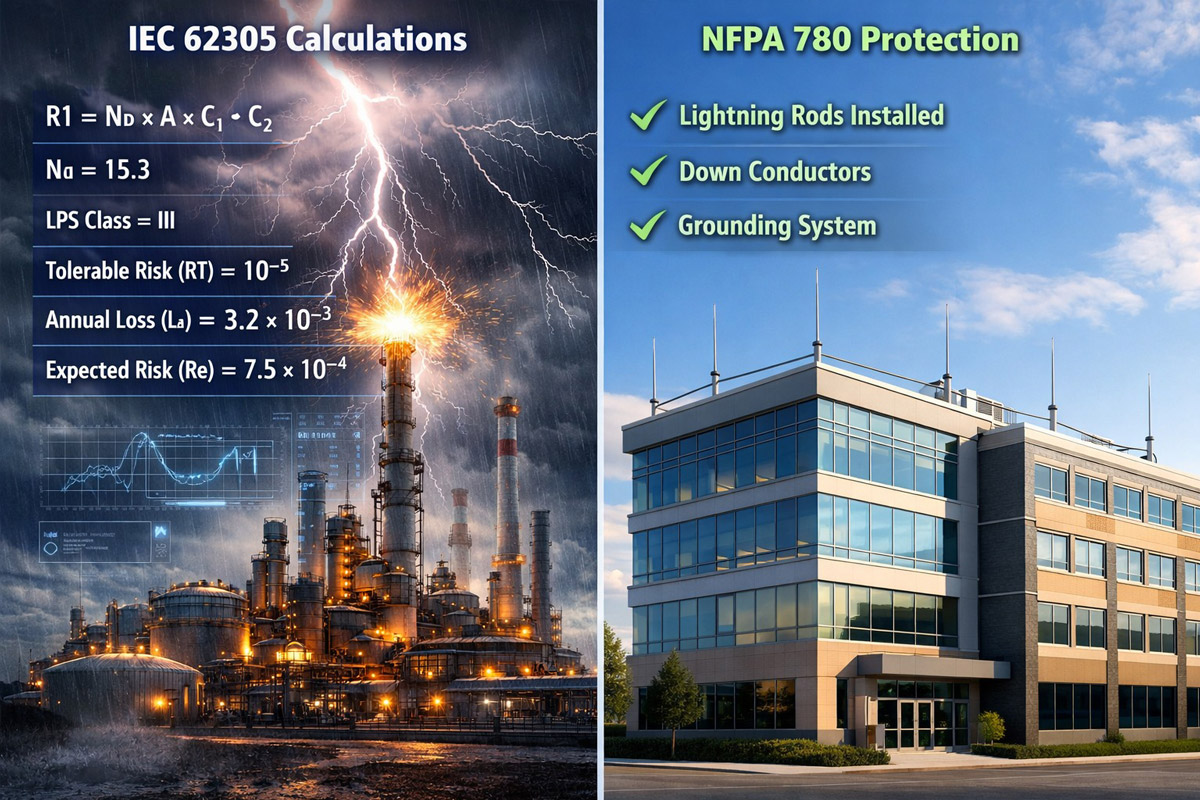
Lightning Protection Risk Assessment Methodologies: IEC 62305 vs NFPA 780
With the rapid expansion of electrified infrastructure and increased system interconnectivity, the consequences of lightning strikes now extend beyond physical damage. A single lightning event can result in operational disruption, failure of sensitive electronic systems, and cascading impacts across critical installations.
For industrial facilities, commercial buildings, and renewable energy assets, lightning protection must be approached as a systematic engineering discipline rather than a purely prescriptive installation practice. A structured risk assessment forms the foundation of any effective lightning protection system (LPS), guided primarily by internationally recognized standards such as IEC 62305:2024 and NFPA 780.
At Wire Consultancy, lightning risk assessment is executed as an engineering-driven process to ensure that protection schemes are not only compliant but also technically justified and optimized for cost and performance.
Transition from Conventional Practices to Risk-Based Engineering
Historically, lightning protection systems were implemented based on empirical rules or legacy design practices. However, increasing asset criticality, higher equipment sensitivity, and stringent reliability requirements have rendered such approaches inadequate.
Modern infrastructure projects require:
- Site-specific risk quantification
- Data-driven protection design
- Compliance with international standards
- Integration with overall electrical and safety systems
This evolution has elevated the importance of structured methodologies such as IEC 62305 and NFPA 780.
IEC 62305: Quantitative Risk-Based Methodology
IEC 62305, developed by the International Electrotechnical Commission, provides a comprehensive, calculation-based framework for lightning risk assessment.
Methodology Overview:
The standard evaluates risk using a probabilistic model incorporating multiple parameters, including:
- Lightning ground flash density (Ng)
- Geometrical characteristics of the structure
- Location and environmental exposure
- Occupancy type and operational criticality
- Presence and sensitivity of electrical/electronic systems
The calculated risk is compared against tolerable risk limits to determine the necessity and level of protection (LPL I–IV).
NFPA 780: Prescriptive Design Framework
NFPA 780, published by the National Fire Protection Association, adopts a prescriptive approach focused on standardized design and installation practices.
Methodology Overview:
The standard provides:
- Defined rules for placement of air terminals and down conductors
- Grounding and bonding requirements
- Material specifications and installation practices
- Simplified criteria for determining protection requirements
Comparative Technical Perspective: IEC 62305 vs NFPA 780
From an engineering and project delivery standpoint, the distinction between the two standards has direct implications:
- Risk Assessment Approach:IEC 62305 provides quantitative risk evaluation; NFPA 780 follows rule-based criteria
- Design Philosophy:IEC enables optimized, site-specific solutions; NFPA promotes standardized configurations
- Application Complexity:IEC is suitable for high-risk, complex systems; NFPA is effective for conventional structures
- Cost Optimization:IEC supports investment justification through risk quantification; NFPA may result in conservative designs
Integrated Engineering Approach
In practical applications, a hybrid methodology often delivers optimal results.
Wire Consultancy adopts:
- IEC 62305 for detailed risk analysis and technical justification
- NFPA 780 principles for efficient and standardized system implementation
This combined approach ensures engineering rigor alongside practical constructability.
Relevance in Indian Conditions
India experiences high lightning flash density, particularly across industrial zones and infrastructure corridors. Despite this, many facilities lack formal lightning risk assessment.
This exposes organizations to:
- Equipment damage and unplanned downtime
- Personnel safety risks
- Insurance and compliance challenges
- Increased lifecycle costs due to inadequate protection
A structured risk assessment enables a transition from reactive protection measures to proactive risk management.
Conclusion
Lightning protection is no longer a compliance-driven requirement but a critical component of business continuity and asset integrity.
While IEC 62305 provides a rigorous, risk-based analytical framework, NFPA 780 offers practical guidance for implementation. The most effective protection strategies are achieved through a balanced application of both methodologies.
For organizations seeking technically robust and cost-effective lightning protection solutions, a structured, engineering-led approach ensures systems are compliant, optimized, and resilient against evolving risks.