
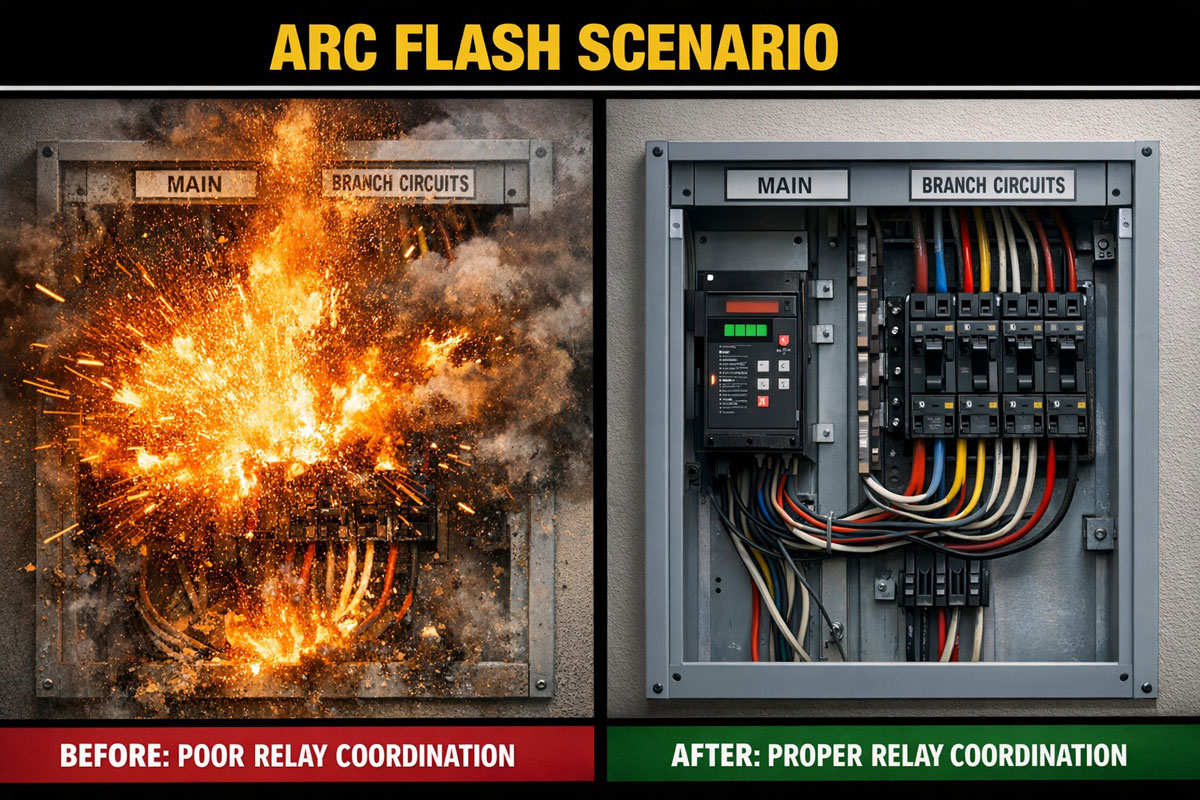
Technical Analysis: Selective Coordination Failures and Protection System Integrity
In high-availability industrial and commercial power systems, the integrity of the Protection and Control scheme is the primary defence against catastrophic failure. Relay miscoordination—the failure to achieve Selective Coordination—represents a latent systemic risk that directly contravenes international safety standards and engineering best practices.
According to IEEE 242 (IEEE Recommended Practice forProtection and Coordination ofIndustrial and CommercialPower Systems), the fundamental objective of protection is to minimize the impact of a fault. When this objective fails, the transition from a localized electrical fault to a facility-wide disaster is often instantaneous.
1. Fundamental Principles of Selective Coordination
Selective Coordination is the systematic application of overcurrent protective devices (OCPDs) such that a fault is isolated by the device immediately upstream, maintaining service continuity to the remainder of the system.
The Hierarchy of Protection:
- Primary Protection: The OCPD closest to the fault (e.g., a branch circuit breaker) must clear the fault within a specified Time-Current Characteristic (TCC).
- Backup Protection: Upstream devices (e.g., feeder or main breakers) must have a programmed Coordination Time Interval —typically 0.2s to 0.5s for mechanical relays or 0.1s to 0.2s for microprocessor-based relays—to allow the primary device to act.
2. Failure Modes and Regulatory Non-Compliance
Failure to maintain coordination is not merely a functional error; it is often a violation of regulatory mandates such as NEC (NFPA 70) Article 240.12 and Article 700.32, which require selective coordination for critical emergency systems.
A. Arc Flash Energy Escalation (NFPA 70E)
The Incident Energy at a point of fault is directly proportional to the clearing time of the protective device. If a relay is mis coordinated and fails to trip, the fault persists until an upstream device clears it. This delay significantly increases the arc flash boundary and the risk of fatal injury to personnel, potentially exceeding the PPE Category ratings established by IEEE 1584 calculations.
B. Thermal and Mechanical Stress (IEC 60909 / IEEE C37)
Delayed fault clearance subjects’ transformers and busbars to prolonged I2t (Thermal Stress) and electromagnetic forces. This can lead to the breaching of the equipment’s Short-Circuit Withstand Rating, resulting in permanent insulation failure or explosive deformation of switchgear.
3. Root Causes of Coordination Degradation
- Inadequate Short-Circuit Studies: Failure to calculate maximum and minimum fault currents based on IEC 60909 leads to incorrect pickup settings.
- System Topographical Changes: The integration of Distributed Energy Resources, such as solar PV or Co-generation, alters fault current contributions, often causing “blindness” or “sympathetic tripping” in existing relays.
- Setting Drift and Hardware Latency: Without secondary injection testing per NETA (International Electrical Testing Association) standards, aging components may fail to meet their programmed TCC curves.
4. Mitigation and Engineering Requirements: The Coordination Study
To mitigate these risks, facilities must perform a formal Protective Device Coordination Study in accordance with IEEE 399 (IEEE Recommended Practice forIndustrial and CommercialPower Systems Analysis).
| Component | Engineering Requirement |
| Data Collection | Accurate modelling of transformer impedances, cable lengths, and motor contributions. |
| Short Circuit Analysis | Determination of bolted fault and arcing fault currents at every bus. |
| TCC Mapping | Overlaying of all protective device curves to ensure no “overlaps” or “touching” occurs. |
| Arc Flash Integration | Optimizing settings to balance selectivity with the need for low clearing times to reduce incident energy. |
5. Conclusion: Professional Compliance and Reliability
Relay coordination is a dynamic requirement. Industry standards—including IEEE and NFPA 70B—increasingly emphasize the necessity of updated electrical studies and proactive maintenance.
For the modern Chief Engineer or Facility Manager, ensuring a coordinated system is a critical requirement for Business Continuity Management (BCM) and professional liability mitigation. A system that is not coordinated is not protected.