In recent years, ESG reporting has moved from a voluntary sustainability exercise to a business-critical disclosure. Companies across industries are publishing ESG reports to showcase their environmental impact, social responsibility, and governance practices. However, a key question still remains for investors, regulators, and stakeholders:
Can these ESG reports actually be trusted?
This is where ESG assurance plays a decisive role. Without independent verification, ESG reports risk being viewed as marketing documents rather than reliable disclosures. ESG assurance bridges this trust gap and significantly improves the credibility of reported data.
The Growing Trust Gap in ESG Reporting
Many organizations today publish ESG data based on internal assessments. While this is a good starting point, it often leads to inconsistencies such as:
- Overstated sustainability achievements
- Incomplete emission disclosures
- Lack of standardized measurement methods
An internal estimate of carbon emissions may vary significantly depending on the methodology used — industry observations suggest this variance can range between 15–25%.This variation can significantly impact how stakeholders interpret a company’s environmental performance.
Similarly, companies may unintentionally omit Scope 3 emissions or use non-uniform ESG metrics, making comparisons difficult across industries.
What ESG Assurance Actually Does
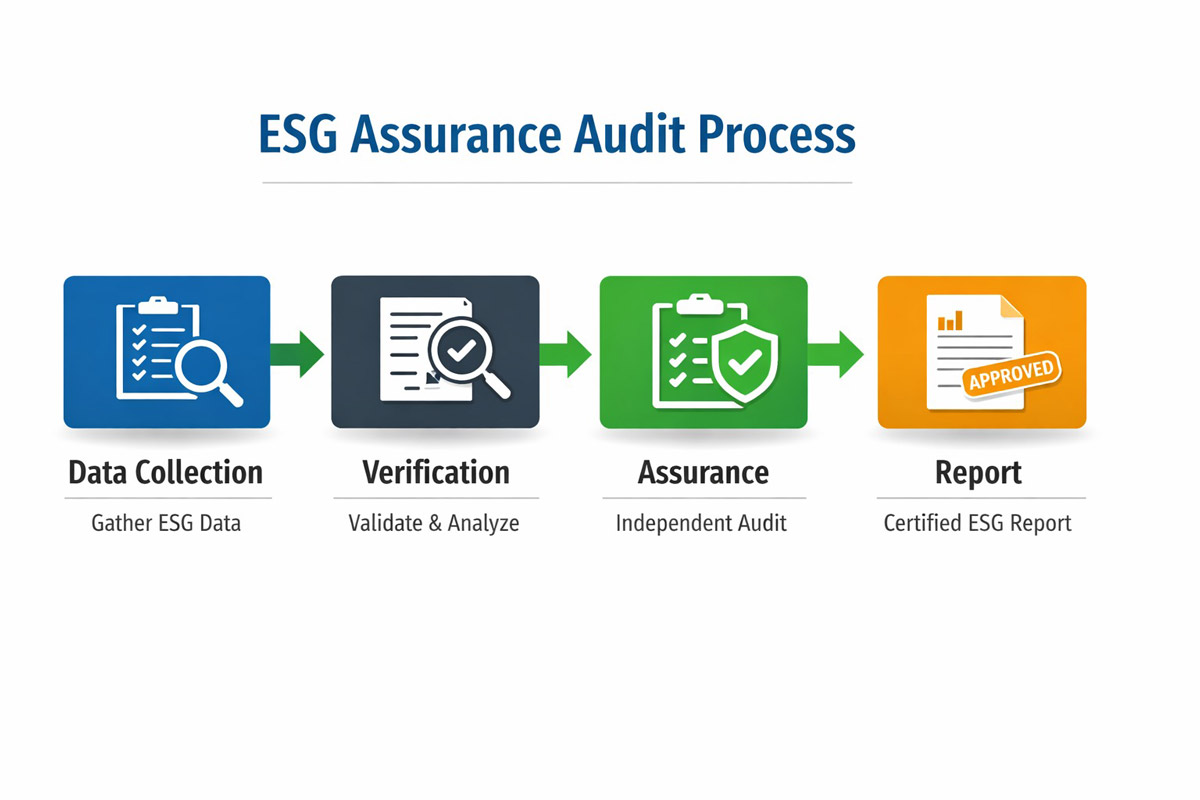
ESG assurance is an independent verification process conducted by third-party experts. It evaluates whether the ESG data presented in a report is:
- Accurate
- Complete
- Consistent
- Aligned with recognized frameworks
Instead of simply accepting reported numbers, assurance providers validate data sources, calculation methods, and assumptions.
For example, if a company claims a 30% reduction in energy consumption, ESG assurance verifies:
- Metering systems and energy logs
- Calculation methodology
- Baseline year comparison
This transforms ESG reporting from a self-declared claim into a verified business disclosure.
Why Credibility Matters More Than Ever
1. Investor Decision-Making Depends on Verified Data
Institutional investors are increasingly integrating ESG metrics into their investment strategies. However, unverified ESG data introduces risk.
A report without assurance is often treated similarly to unaudited financial statements—useful, but not fully reliable.
In contrast, assured ESG reports:
- Increase investor confidence
- Improve access to capital
- Support better valuation assessments
2. Regulatory Pressure Is Increasing
Globally and in India, ESG disclosures are becoming more structured and regulated. Frameworks like Business Responsibility and Sustainability Reporting (BRSR) are pushing companies toward transparency.
Regulators are gradually moving toward mandatory assurance requirements, especially for large and listed companies.
Organizations that adopt ESG assurance early are better prepared for:
- Future compliance requirements
- Reduced regulatory scrutiny
- Faster reporting cycles
3. It Reduces the Risk of Greenwashing
Greenwashing is one of the biggest credibility risks in ESG reporting. Companies may unintentionally or deliberately present an overly positive sustainability image.
ESG assurance acts as a control mechanism by:
- Validating claims with evidence
- Highlighting data gaps
- Flagging inconsistencies
A practical observation across industries shows that companies undergoing ESG assurance often identify 5–10% data discrepancies during initial verification. Correcting these early prevents reputational damage later.
4. Enhances Internal Data Discipline
Beyond external credibility, ESG assurance improves internal processes.
Organizations that go through assurance typically:
- Strengthen data collection systems
- Standardize ESG KPIs across departments
- Improve documentation and traceability
Over time, this leads to more efficient and reliable ESG reporting cycles.
Limited vs Reasonable Assurance: What Companies Should Know
ESG assurance is generally provided at two levels:
- Limited Assurance: Provides moderate confidence, commonly used in early-stage ESG reporting
- Reasonable Assurance: Offers a higher level of confidence, similar to financial audits
Most companies begin with limited assurance and gradually transition to reasonable assurance as their ESG systems mature.
ESG Assurance as a Business Advantage
While many organizations still view ESG assurance as a compliance requirement, forward-looking companies are using it as a strategic advantage.
Credible ESG reporting can directly impact:
- Brand reputation
- Investor trust
- Client acquisition, especially in global supply chains
For example, multinational corporations increasingly prefer vendors with assured ESG disclosures, as it reduces supply chain risk.
How Wire Consultancy Supports ESG Assurance
At Wire Consultancy, ESG assurance is approached not just as a verification exercise, but as a structured improvement process.
The focus is on:
- Reviewing ESG data systems and methodologies
- Aligning disclosures with global frameworks
- Identifying gaps before final reporting
- Supporting accurate and audit-ready ESG documentation
This ensures that ESG reports are not only compliant but also credible and decision-useful.
ESG reporting without assurance is no longer sufficient in today’s data-driven business environment. Stakeholders expect transparency, accuracy, and accountability.
ESG assurance strengthens all three.
It converts ESG reports from self-reported narratives into verified disclosures, enabling organizations to build trust, reduce risk, and create long-term value.
For companies aiming to stand out in a competitive and compliance-driven market, ESG assurance is not an optional step—it is a necessary one.
Ready to strengthen your ESG reporting? Start by identifying where your current data gaps lie — and take the first step toward assurance-backed credibility.